
Keelwake trip equipment
Pack by function. Sail with clarity.
Focused guidance for marine distress equipment and personal sailing-trip packing, based on route, crew and rescue chain.
One guide covers distress equipment and the rescue chain; the other helps you pack personal equipment for the trip.
2 onboard guides
Safety equipment and personal packing.
Start with the route, crew and rescue chain. Product categories come after the operational requirement.
Trip guide
Marine distress signals on board
How visual signals, beacons and personal equipment fit the cruising area, and where the German FKN becomes relevant.
Open guideTrip guide
Packing list for a sailing trip
A short list of personal items that genuinely improve safety, communication and life on board.
Open guideStart with the trip
Useful equipment begins with a scenario, not a shopping list.
A weekend in sheltered waters, a night passage along a coast and an offshore leg expose a crew to different weather, response times and rescue options. Define the sailing area, season, expected conditions, number of people and experience on board before comparing products. The skipper and applicable rules decide what must be carried; a recommendation page can only help structure that decision.
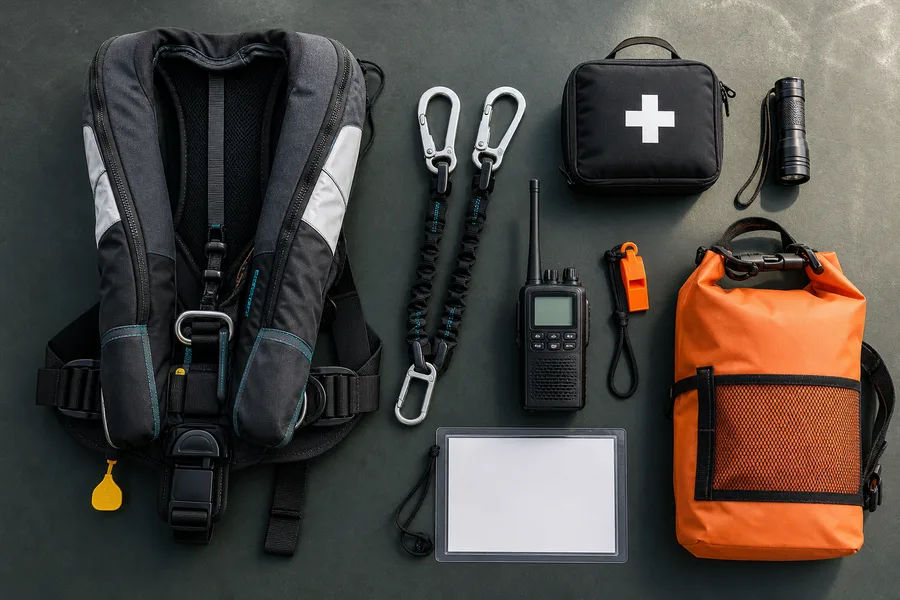
Separate boat equipment from personal equipment. Fixed radios, emergency beacons and pyrotechnic signals belong to the vessel and its rescue chain. A correctly fitted lifejacket, suitable clothing, medication and personal documents belong to the individual. That separation prevents duplicate purchases and makes the handover between owner, charter company and crew much clearer.
From selection to routine
Equipment only helps when the crew can reach and use it.
Distress equipment should be planned as a chain: attract attention locally, alert rescuers over radio or satellite and keep people visible and afloat until help arrives. More devices do not automatically make that chain stronger. Registration, battery status, mounting, range and the crew briefing are often more important than adding another category.
A personal packing list follows the same principle. Start with protection from cold, wet and sun, then add medication, documents and the few items needed for the actual watch system. Pack by function in soft, water-resistant bags and keep safety-critical items accessible. Heavy luggage and duplicate gadgets make a small yacht less orderly without improving the trip.
Inspect equipment before every departure rather than only when buying it. Check lifejacket cylinders and lights, tether condition, radio charge, beacon registration and the contents of first-aid kits. Replace expired or damaged parts according to manufacturer and authority guidance. A short documented check is more useful than assuming that equipment stored on board is ready.
The two Keelwake guides deliberately stay narrow: one explains distress signals and the rescue chain, the other organises personal sailing-trip packing. Product links illustrate suitable categories, not a universal kit. Availability changes, so approval, current service status and the requirements of authorities, flag state, charter company and skipper always take priority.