
Study guide · FKN
Distress signal certificate (FKN)
The official catalogue holds sixty questions. This guide explains the subject behind them — every question has its paragraph, and no answer stands without the reason it is correct.
Chapter 1 · 6 questions
What pyrotechnic distress signals are
A distress signal that works with explosives is not a firework. The difference is not a matter of taste — it is the reason there is a separate law for it.
The definition everything else rests on
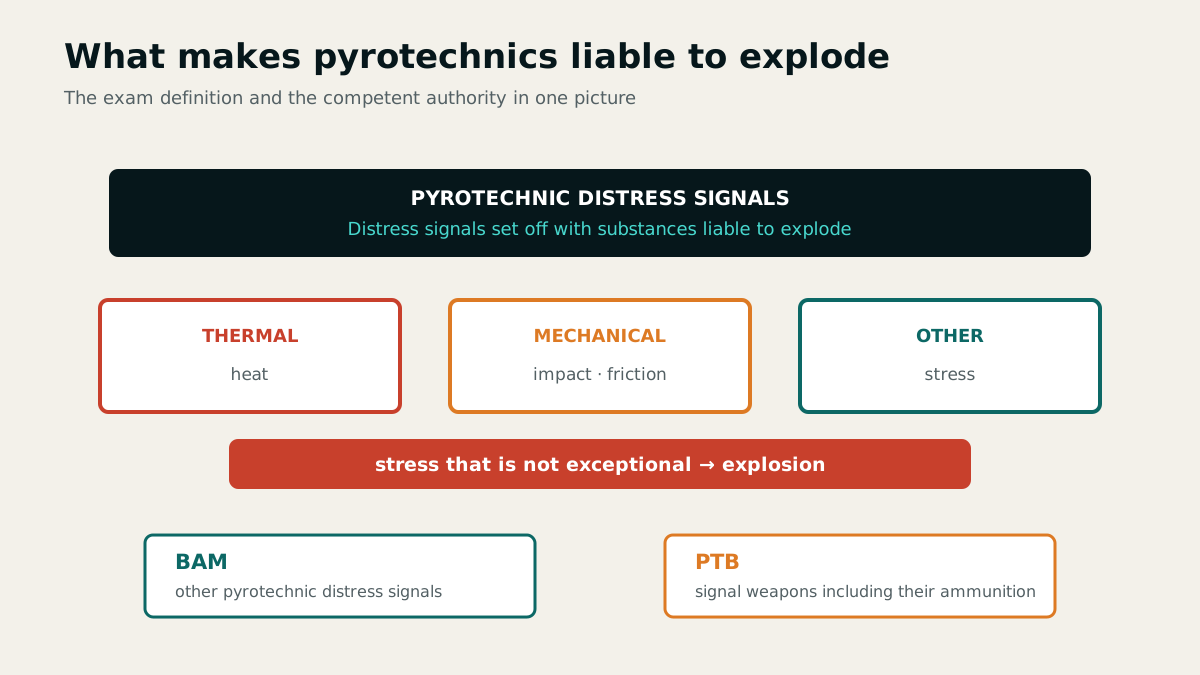
Pyrotechnic distress signals are signals triggered by means of explosive substances. That is the wording the examination expects, and it is more precise than it sounds: not „with fire“, not „with flares“ — with explosive substances.
Explosive substances are solid or liquid substances and preparations that can be caused to explode by non-exceptional thermal, mechanical or other stress. The definition describes a possible response to such stress; it does not mean that every knock or warm day inevitably causes an explosion.
Why they are more dangerous than any other piece of equipment
Pyrotechnic charges carry a risk of explosion, fire and injury. The sentence most often forgotten in the examination stands behind it: they keep burning in water.
That is no footnote. It means a misfire you throw overboard keeps burning. It means a smoke signal thrown to leeward works as intended. And it means the obvious idea — into the water and it is out — is wrong.
Who oversees this
Handling explosive substances is governed by the Explosives Act (Sprengstoffgesetz). Pyrotechnic distress signals are tested and approved by the Federal Institute for Materials Research and Testing, BAM for short.
Its approval mark appears on every item and tells you the sub-class at the same time: BAM-PT1 or BAM-PT2. On this single detail hangs whether you may buy the signal freely or need proof of competence — see chapter 4.
Chapter 2 · 10 questions
The four signalling devices
Four types are carried on board. They differ not in purpose but in range — and from that follows the order in which you use them.
What is carried on board
Carried on board are signal rockets, parachute rockets, hand flares and smoke signals. If the examination asks for six pyrotechnic distress signals, two rarely seen ones are added: light-smoke signals and flash-bang cartridges.
The colour is set internationally and is not a matter of taste: light signals are red, smoke signals orange. A green or white rocket is not a distress signal — nor will it be understood as one.
The hand flare
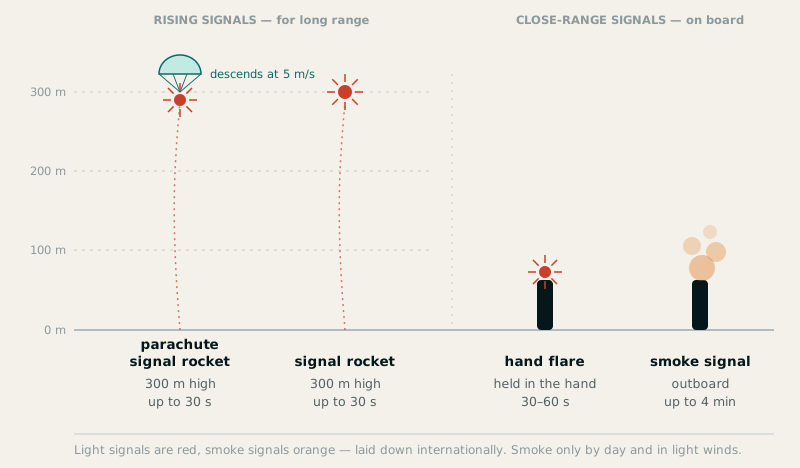
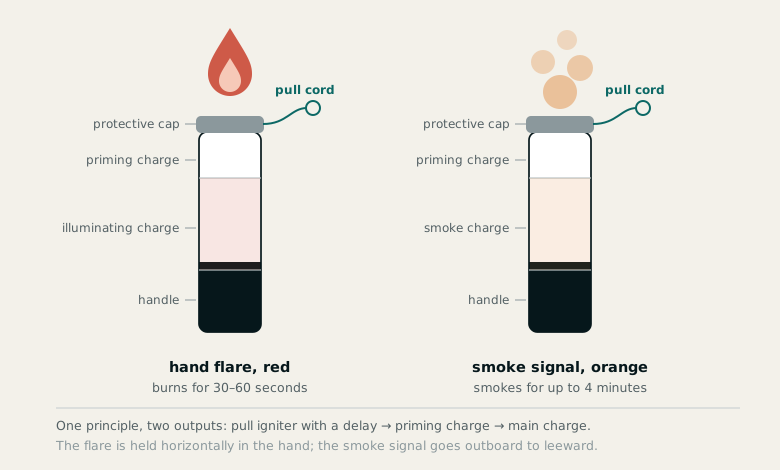
A hand flare burns for 30 to 60 seconds. It does not rise; it shows: I am here.
There are two ways to ignite it. Friction-cap ignition works like a match and lights the flare composition directly after a delay — it is no longer sold in Germany. Today the pull igniter is usual: a wire inside is drawn through a friction-sensitive priming composition, which then lights the signal charge.
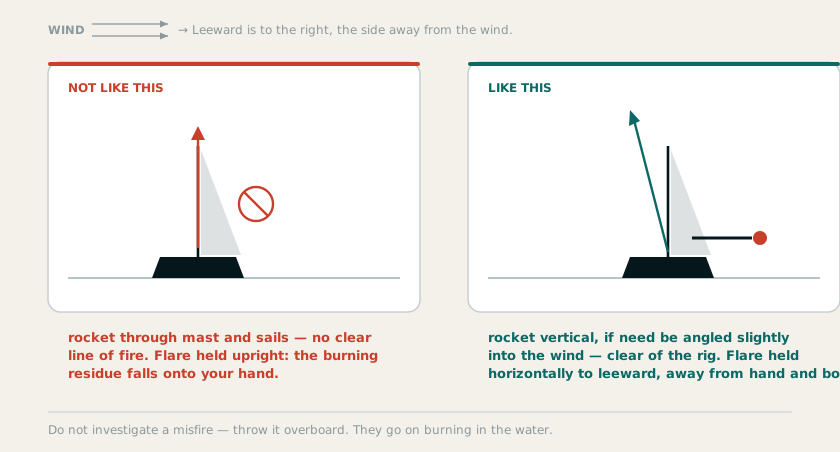
Two safety rules apply. First: follow the instructions. Second, and this is where people get hurt — always hold the burning flare to leeward and horizontally, so that sprayed residue harms neither hand nor eyes nor the yacht.
The smoke signal
Inside a container sits an igniter — usually a pull igniter — with a delay. It lights a pyrotechnic charge that gives off orange smoke for up to four minutes.
The pull cord lies under a screw-off protective cap. Once lit, the smoke signal is thrown overboard to leeward.
Two limits make the smoke signal a specialist: it works only by day and only in light winds. In wind the plume disperses before anyone sees it.
Rocket and parachute rocket
Signal rockets rise to 300 metres and burn for up to 30 seconds.
The parachute is the whole difference. Rockets and cartridges fitted with a parachute descend at only 5 metres per second. The lower rate of descent allows a longer burn time — and the longer burn time means a higher chance of being noticed. A signal star without a parachute falls faster and is visible for correspondingly less time.
Chapter 3 · 15 questions
When and how to use them
The commonest mistake is not the wrong grip but the wrong moment. A signal nobody sees is lost — and you have only a few.
Only in an emergency — and what that means
Pyrotechnic distress signals may be used only in an emergency. The emergency is defined: when it is to be indicated that there is danger to life and limb and that help is needed.
The examination tests this with a trap. Use is also permissible when substantial property is in danger and outside help is urgently needed. What is not correct is the restriction „only once all other means of communication have failed“ — that appears nowhere.
In a distress situation anyone may fire. No firearms competence certificate is required and it need not be the skipper. Anyone may use class T who wishes to indicate that a distress situation exists.
The order: far first, then near
Parachute rockets and hand flares are visible at different distances in clear weather — and that dictates the tactics.
The parachute rocket alerts distant helpers to the emergency and gives them a rough bearing. The hand flare marks the exact position once help is approaching.
For the smoke signal the rule is stricter still: by day only — and only once help has been sighted. Smoke into an empty horizon is wasted.
Rising signals: four rules
For all rising distress signals the following applies without exception:
- Ensure a clear line of fire — mast and sails are in the way.
- Hold the device vertically upwards, if necessary inclined slightly into the wind.
- When handling and firing, do not point at people and keep your own limbs and clothing clear of the muzzle.
- Do not tamper with misfires — throw them overboard.
To this the examination adds a fourth condition: no flammable objects within the danger area.
Burning pyrotechnic projectiles continue burning in water. Water therefore does not render them harmless. The correct choice in this question is “Yes”; the other two alternatives are false.
Where this is laid down
The use of distress signals at sea is governed by the Collision Regulations (COLREG), Rule 37. The duty to render assistance in distress is governed by the German ordinance on the safety of seafaring.
Two publications of the Federal Maritime and Hydrographic Agency (BSH) belong here: the booklet „Sicherheit im See- und Küstenbereich“ sets out the seamanlike duty of care for water sports, and the handbook „Suche und Rettung“ contains guidance for dealing with emergencies at sea.
Chapter 4 · 20 questions
Who may buy and possess what
A third of the examination turns on this question. It is simpler than it looks once you grasp one dividing line: does it come out of a signal pistol or not?
The dividing line: two acts
The Weapons Act covers the signal pistol and the ammunition intended for it — that is, all signal pistols and launching devices together with their ammunition.
The Explosives Act covers all pyrotechnic distress signals that are not fired from a signal pistol: signal rockets, hand-held parachute rockets, hand flares and smoke signals.
This one question — does it come out of the pistol? — decides which act applies. Everything else follows from it.
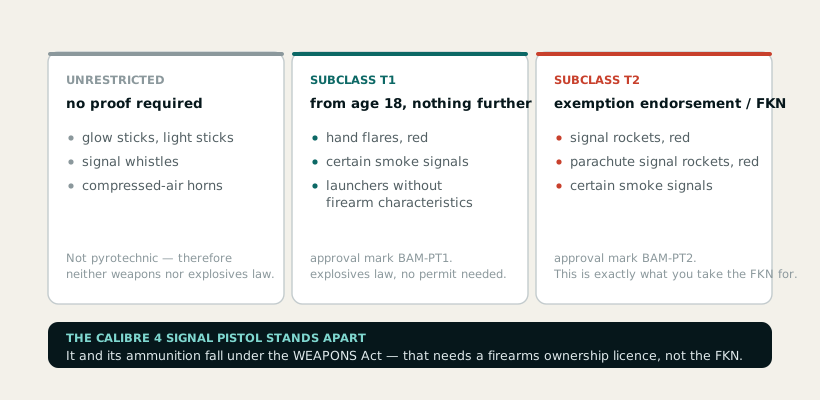
T1 and T2: the two sub-classes
Sub-class T1 may be acquired, kept and used by anyone aged 18 or over — without any permit. It covers „hand flares, red“, certain smoke signals and launching devices that are not firearms.
Sub-class T2 requires a permit. Water sports users may acquire it with an exemption endorsement printed in their licence, that is, the distress signal certificate. It covers „signal rockets, red“, „parachute signal rockets, red“ and certain smoke signals.
Which sub-class applies is shown by the approval mark: BAM-PT1 or BAM-PT2. Acquisition is by purchase or transfer — in both cases on production of the relevant entitlement.
In distress at sea, anyone may use class T pyrotechnic distress signals to indicate the emergency, particularly danger to the crew's life or physical safety and the resulting need for assistance. Entitlement to acquire signals and using them to indicate actual distress are different questions.
The calibre 4 signal pistol
Permitted for pyrotechnic distress signalling are the calibre 4 (26.5 mm) signal pistol and signal weapons approved by the PTB including their ammunition, as well as other distress signals approved by the BAM.
Here lies the trap most candidates fall into: the exemption endorsement in the boating licence does not entitle you to acquire calibre 4 distress signal ammunition. That requires a firearms ownership card with an entry authorising the acquisition of calibre 4 ammunition.
The firearms ownership card entitles the holder, with the appropriate entry, to acquire and possess a signal pistol, and with a further entry to acquire the matching ammunition. It is applied for at the competent authority of your place of residence — not of your berth.
What is freely available
Signal weapons bearing the PTB type-approval mark — the „PTB in a circle“ — may be freely acquired and carried on board. These are precisely the ones the holder of a small firearms licence may carry.
Requiring nothing at all are the non-pyrotechnic means: glow sticks, signal whistles, compressed-air horns. Available to anyone, without proof and without an age limit under explosives law.
Making, transferring, losing
You may not manufacture or work on pyrotechnic articles yourself. Only holders of a special permit under the Explosives Act may do so.
Permanent transfer of distress signals is allowed only to persons entitled under weapons or explosives law.
Temporarily you may hand the calibre 4 signal pistol and its ammunition, without a permit, to adults you trust for safe keeping. And there is an exception that makes chartering possible in the first place: the charterer of a seagoing yacht may exercise actual control over a calibre 4 signal pistol on board and its ammunition without a weapons permit.
Chapter 5 · 9 questions
Storing, checking, disposing
A signal that fails in an emergency is worse than none — because you were relying on it. Shelf life is therefore not an administrative matter.
Three years, and what shortens them
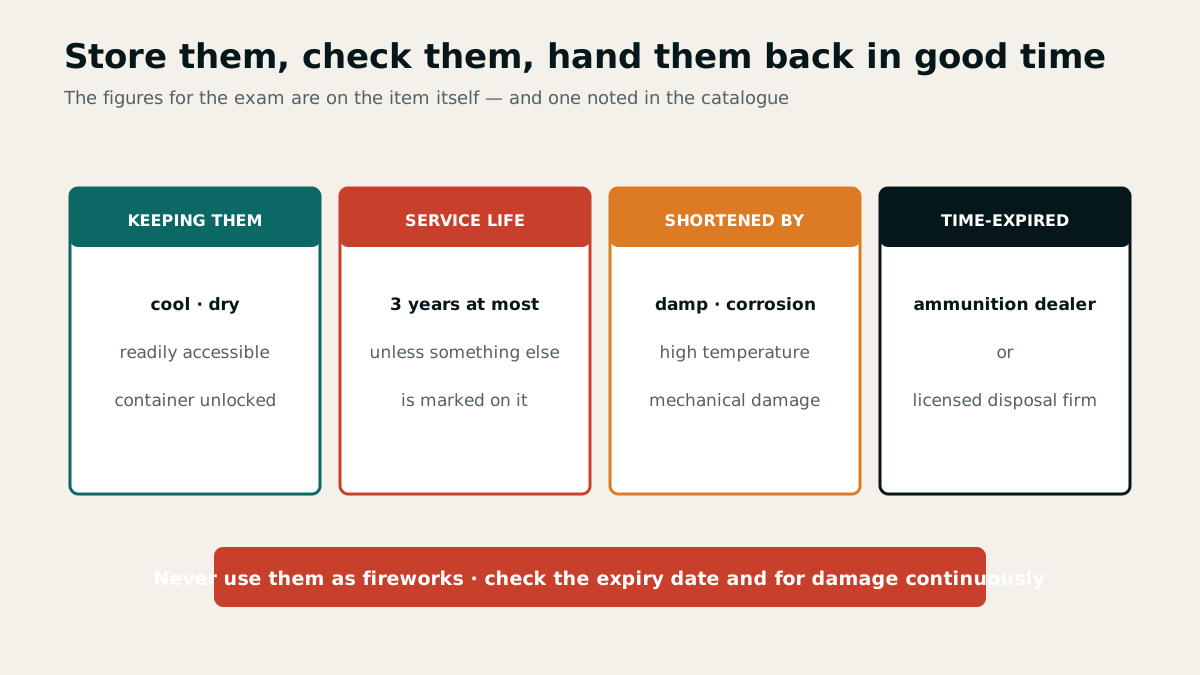
Properly stored, pyrotechnic distress signals have a shelf life of at most three years — unless the individual item states otherwise.
Four things shorten or impair it: moisture, corrosion, high storage temperatures, mechanical damage. All four are the normal state on board if you are not careful.
Two things must therefore be monitored continuously: the shelf life or expiry date — and the condition, that is, corrosion or damage.
How they are stowed on board
Under way, pyrotechnic distress signals are to be kept cool and dry and readily accessible in unlocked containers.
The second part surprises many. Unlocked is not an oversight but deliberate: in an emergency seconds count, and nobody goes looking for a key.
The instructions
Immediately after purchase — not first in an emergency — the instructions are to be read carefully to the end. The signals themselves carry handling instructions.
This sounds like a formality and is the most practical rule in the whole catalogue. At night, in a seaway, with wet hands, nobody reads small print any more.
Expired, in transit, lost
Expired distress signals are returned through the ammunition trade or handed to disposal firms. On no account use them as fireworks — they are no substitute for New Year, and they are not approved for it either.
Distress signalling devices may not be carried on public transport. Not on the train, not on the bus to the harbour.
If signalling devices or weapons go missing, the loss must be reported to the competent authority without delay.