
Study guide · SBF Binnen
Inland and Coastal Powerboat Licence (Inland)
The official catalogue contains three hundred questions. This study guide explains the material behind them — and shows where the questions follow a system that can be understood rather than memorised.
The captions under the picture boards keep the official German wording of the examination answers. The examination is held in German, and that exact wording is what counts in it.
Chapter 1 · 30 questions
Law, papers and responsibility
The legal foundations govern responsibility, fitness to proceed and conduct on the water. Keep the categories of vessel apart from the requirements for the licence.
The twenty-metre threshold
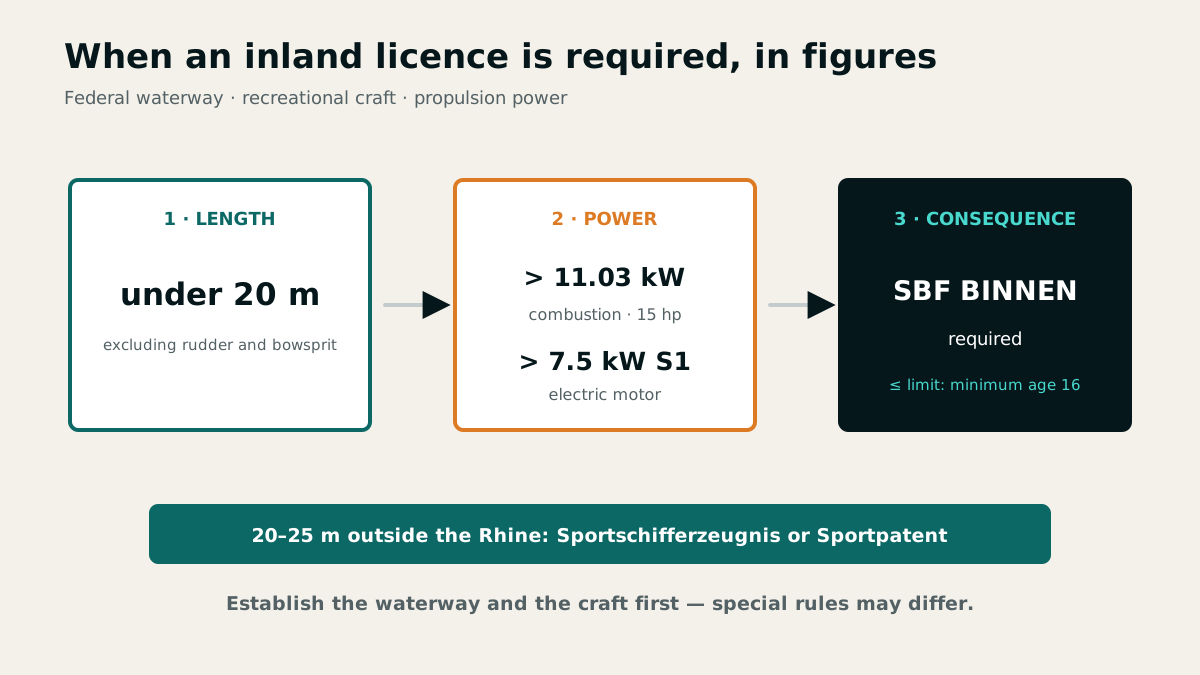
On inland waterways a recreational craft counts as a small craft if it is less than 20 m long. From 20 m it is no longer one.
The same figure limits the licence: the inland recreational craft licence entitles you to command up to a length of less than 20 m — excluding rudder and bowsprit. The addition is no quibble: on a boat with a long bowsprit it decides whether you may command her at all.
On the Rhine a special rule applies: there the Sportpatent covers lengths up to 25 m.
The power threshold: 11.03 kW
Besides the twenty metres there is a second figure on which everything hangs: 11.03 kW (15 hp) of usable power with a combustion engine, 7.5 kW with an electric motor in duty type S1 (continuous operation).
- Above it the inland recreational craft licence is required — for boats under 20 m in length.
- Up to and including these limits a minimum age of 16 suffices, alongside fitness and aptitude.
- A recreational craft with an electric motor may be commanded without a licence where the propulsion power is 7.5 kW S1 at most.
On the Rhine, above this limit the inland recreational craft licence is required for recreational craft with propulsion machinery, or an equivalent certificate of competence. For boats of 20 to 25 m outside the Rhine: the Sportschifferzeugnis or the Sportpatent.
You may hand over the helm to a person who is at least 16 years old and physically, mentally and technically fit for it.
Who commands, and when they may not
If it is not settled before departure who the master is, a master responsible for the vessel must be appointed. Not elected, not drawn by lot — appointed. There is exactly one person responsible on board.
No one may command the vessel or independently determine her course or speed who is impaired in safe command by physical or mental deficiency or by alcohol or other intoxicants — or who has a blood alcohol level of 0.5 per mille or more.
The helmsman must be capable of steering safely: able to receive and give all information and instructions, to hear all sound signals and to have an adequate clear view in every direction. Someone who can neither hear nor see does not steer.
Where the licence is valid and when it is withdrawn
The inland recreational craft licence is valid on the federal waterways in the inland area. It must be withdrawn for lack of fitness or lack of reliability — two grounds, no more.
Away from the federal waterways — on state, municipal and private waters — the owner's permission may have to be obtained and the relevant navigation rules observed. A federal licence opens no private lake.
Taking part in inland waterway radio requires a certificate of its own: the VHF radiotelephony certificate for inland waterways (UBI).
Marks of identification and the register
There are two kinds of marking: official and officially recognised marks. The officially recognised ones consist of the number of the International Certificate for Pleasure Craft, followed by the identifying letter of the issuing organisation.
A water sports craft must be entered in the inland vessel register from 10 cubic metres of displacement.
Where the information is found
Three questions test whether you know where to look things up — and the answers overlap:
- Traffic restrictions and current information: the Waterways and Shipping Administration, www.elwis.de, the water police.
- Speed limits: the Inland Waterways Regulations, the Waterways and Shipping Administration, the water police.
- Inland waterways and their boundaries: Part II of the Inland Waterways Regulations.
It can be remembered as one rule: everything current is with ELWIS and the administration, everything laid down is in the regulations — and the boundaries specifically in Part II.
Which regulations apply where
Four bodies of rules, four areas of application — the exam asks about them in pairs:
- The Inland Waterways Regulations and the Rhine Navigation Police Regulations — general traffic rules for inland waterways and for the Rhine.
- The Moselle and Danube Navigation Police Regulations — for the Moselle and the Danube.
- The Personal Watercraft Ordinance and the Water-skiing Ordinance — for personal watercraft and water-skiing.
For personal watercraft a restriction applies away from the designated stretches: there they are permitted only on touring and cruising passages on a clear straight course — no turning circles, no jumping.
Responsible for official marks is any Waterways and Shipping Office; for officially recognised ones the German Motor Yacht Association, the German Sailing Association and the ADAC.
Chapter 2 · 30 questions
Fairway, buoys and water level
Five questions want to know on which side of your vessel you pass a buoy. They look like five problems and are one — as soon as you know where “right” and “left” on a river take their names from.
The fairway is not the channel
The two terms are confused in everyday use and asked about separately in the exam.
The fairway is that part of the waterway which is used by through traffic according to local conditions. It is therefore a description of what actually happens.
The channel is the part in which particular widths and depths are maintained or aimed at for through traffic. “Aimed at” is no guarantee of the depth on the day; the water level and the nautical information remain to be observed.
Where right and left come from — and why that explains everything
On rivers the banks are named going from the source to the mouth. That is the one definition from which all the rest follows. It hangs on the river, not on you: the right bank stays the right bank whichever way you are going.
The buoys follow that definition:
- Right side of the channel — red can buoys or spar buoys.
- Left side of the channel — green conical buoys or spar buoys.
And now the rule that answers five exam questions at once: going downstream you travel in the direction of buoyage — right is to starboard. Going upstream you travel against it — right is to port.
Check it against the questions: downstream, red buoy ahead → right side, pass it to starboard. Upstream, red buoy → right side, to port. Upstream, green buoy → left side, to starboard. The same reasoning three times.
The two directions of travel are named accordingly: on rivers upstream is travel towards the source, downstream travel towards the mouth. On canals there is no current to settle it — there what counts as upstream is laid down, in Part II of the Inland Waterways Regulations.
The remaining buoy colours
Red and green striped means a division of the channel: the channel divides and you may pass on either side.
Yellow buoys mark a protected bathing area. Yellow buoys with a radar reflector off bridge piers have a different task: they make the piers visible on the radar screen — for commercial traffic at night and in fog, not for your eye.
A red pennant at the bow belongs not to the buoyage but to the vessel: she has priority at locks.
At the bridge shown, the yellow diamond marks a recommended passage with two-way traffic. The red and white boards at the sides at the same time bound the permitted bridge passage. Recommendation, two-way traffic and the lateral limits are three parts of the same answer.

Water level: two marks, two consequences
Shipping is informed about water levels and flood marks by the nautical information radio service, and by radio, television and the internet. On the spot you read it from the gauges and the designated flood marks.
The two marks represent an escalation:
- Flood mark I — a speed limit and a prohibition on proceeding for vessels without radiotelephony.
- Flood mark II — navigation is suspended.
In flood conditions it also holds that you adapt your speed and keep to the middle of the fairway as far as possible — there the current is most even and the danger from flooded banks least. Particular speed limits and restrictions on navigation are to be observed.
On flood mark II being reached, the passage must be broken off without delay — not at the next harbour, at once.
Locks, mooring prohibitions and shore power
For locking through together a fixed order applies: small craft enter only after the vessels that are not small craft — and only when called forward by the lock keeper.
A general prohibition on mooring exists without any special marking on ship canals and lock canals. No board is needed there; the prohibition applies of itself.
And one point that has nothing to do with navigation and stands here nonetheless, because it saves lives: a residual current device must be installed in the shore power supply. Boat, water and 230 volts get on with one another only by way of that one fitting.
Consideration along the way
Approaching vessels moored to the bank in a narrow waterway, you reduce speed in order to avoid harmful suction and wash. A boat on a line cannot get out of the way.
When passing vessels, floating bodies or bathers, the water-skier must stay in the wake of the towing boat — no swinging out where anyone is.
The general duty of care sums up what it is all about everywhere: avoiding danger to human life, damage to vessels, installations or banks, obstruction of navigation and harm to the environment. Four things to protect, in that order.
Before navigating waters that are new to you, you inform yourself of the provisions in force there — simply so as to be able to comply with them. The Inland Waterways Regulations do not apply everywhere.
Chapter 3 · 55 questions
Boards and visual signs
Fifty-five questions — more than any other area. Forty-four of them show a picture and ask what it means. Learn them one at a time and you learn forty-four things. Know the three systems behind them and you can derive most.
Boards stand on the bank, visual signs are carried on board
The difference sounds obvious and still decides what you look for. Boards stand fixed along the waterway: on bridges, locks, banks. They apply to the stretch. Visual signs a vessel carries with her — balls, cones, cylinders, flags. They say something about that vessel.
Visual signs almost always have a night-time counterpart: what is a blue cone by day is a blue light by night. It is therefore worth reading this chapter together with the one on lights — they are two languages for the same statements.
First system: red is closed, green is clear
With floating plant and with vessels aground or sunk, the colour and the complete arrangement of the signs decide. A single colour is not enough.
- On floating plant the green side means: passing permitted; the red side is closed.
- In the variant with a red and white marking, passing is permitted there but suction and wash are to be avoided. A side marked purely red alongside it remains closed.
- Among the boards, green-white-green is the clear side and red-white-red the closed one. The arrangements shown as clear on both sides permit passing on either side.
Distinguish the type of vessel as well: in the illustration assigned here, the red-and-white/red combination marks a vessel aground or sunk. For the other working signs shown here the answer is floating plant at work. Both belong to the exam alongside the permitted side.


Second system: blue cones count like blue lights
Dangerous cargo is indicated by day with blue cones and by night with blue lights — and the number means the same in both cases:
- One cone — flammable substances, distance when berthed 10 m
- Two cones — substances harmful to health, 50 m
- Three cones — explosive substances, 100 m
Anyone who has learned the lights already knows the cones. This is one of the few places in the catalogue where two groups of questions settle each other.


Third system: the prohibition signs
Many prohibition signs show a red border, a white field, a symbol and a red diagonal bar. That is a common design but not a complete rule: the red-white-red no-entry sign is also a prohibition, and it has no diagonal bar.
Every board is therefore learned from its complete picture. The prohibition sign for machinery shown here forbids the passage of vessels under power, not of small craft alone. The minimum-distance sign gives the distance to be kept in metres; it applies to the stretch that follows from where the sign stands.


Bridges and passages
Boards on bridges say where you pass through and whether anyone is coming the other way. The distinction the exam asks about is between permitted and recommended:
- Prescribed or prohibited — passage between the two boards is permitted, everything else is not.
- Recommended — the opening is the intended one but not the only permissible one.
Then there is the direction: some passages are permitted both ways, others one way only, and others again are recommended with or without oncoming traffic. The board says so; you have only to tell whether it prescribes or recommends.


Berths, weirs and speed
Some signs concern lying up and the stretch. With berths, the decisive question is whether small craft may lie there: berths for vessels carrying explosive substances are prohibited to them, berths for vessels without dangerous goods are open to small craft as well.
A sign of its own warns of a weir — not one piece of information among many but a warning of an installation where recreational craft come to grief regularly.
With the speed signs there is a peculiarity readily overlooked: the figure refers to the speed relative to the bank, not through the water. In a current that makes a considerable difference.


Obstructions at the bank: cone up or cone down
Groynes — the stone spurs projecting into the water — are marked with poles and topmarks. Which side of the waterway is meant is given by the colour and the way the cone points:
- Right side: red, cone point down. Alternatively a red and white striped spar buoy with a red cylinder.
- Left side: green, cone point up. Alternatively a green and white striped pole, or a green buoy with a green cone, point up.
And if you have touched bottom within the fairway yourself, you are obliged to report it: to the Waterways and Shipping Administration or the water police, with the exact position of the obstruction. An unknown obstruction in the fairway endangers the next person along.
The blue board with the white flashing light
A vessel showing a blue board with a white flashing light on the starboard side of her wheelhouse is announcing: we shall pass starboard to starboard — not, as is otherwise usual, port to port.
For you as a small craft an important restriction applies: the sign does not apply to small craft. It does, however, oblige you to increased attention — the master of the large vessel expects traffic there and is not reckoning with you.
The same rule applies at a lock: if a vessel with a blue board comes out of the chamber, the commercial vessels pass starboard to starboard, and the small craft is obliged only to increased attention.
Red flags — three different meanings
Here lies a genuine trap, because the same colour stands for three things and the exam asks about them separately:
- A red flag moved in a circle — a vessel in distress, calling for help.
- A red flag swung in the lower half-circle — the vessel is not under command. At night a red light is swung in the same way instead. The catalogue names four short blasts with it.
- A red and white flag — a vessel in need of protection: reduce speed, avoid suction and wash, pass at as great a distance as possible.
The difference is the movement: circling means distress, swinging in the lower half-circle means not under command. And red and white is no call for help at all but a request for consideration.

Suction and wash: everywhere you slow down
“Avoid suction and wash” appears on a board of its own — but the duty applies without any board at five places, and the exam asks for them as a list:
- off harbour entrances
- at loading, discharging and lying-up berths
- near ferries not running on a fixed line
- on marked stretches
- near floating plant at work
Water-skiing, finally, is permitted only where a board releases the area for it — not everywhere that nothing is forbidden.
The yellow cylinder with black and white stripes shown marks the towing vessel at the head of a towing convoy.


Chapter 4 · 35 questions
Lights
At night all you see of another vessel is points of light. From their colour, number and arrangement you read what is out there, where it is going and who must give way. That is no exercise in memory but a language with few words.
When and what for
Lights are carried from sunset to sunrise and in restricted visibility. Not in darkness — the rule attaches to the position of the sun, and fog at midday counts just as much.
What they are for is an exam question of its own with a short answer: they show a vessel's direction of travel and position. Not her size, not her name — direction and position.
The four basic lights and their arcs
Masthead light, sidelights and sternlight form the basis of the lights carried. Their colours and arcs are frequently examined; particular conditions of a vessel add further lights.
- Masthead light — white, 225°, forward
- Sidelights — port red, starboard green, 112.5° each
- Sternlight — white, 135°, aft
Together the figures make the full circle: 225° forward plus 135° aft is 360°. And two sidelights of 112.5° each make exactly the 225° of the masthead light. Work that out once and you need not learn the numbers by heart.
What that tells you about the direction
A red sidelight shows the port side, a green sidelight the starboard side. Both sidelights together mean you are looking at the other vessel from ahead. A white sternlight shows her from astern. A single white light may, however, also be an all-round light: without further features no stern and no direction of movement can safely be derived from it.
The crossing questions aim at exactly this. A vessel with a bicolour lantern and a masthead light coming up from astern is a small craft under power. A vessel approaching with one white light only is a small craft not under power.
Small craft: the relaxations
Exceptions apply to boats under 20 metres, and the exam asks about them specifically.
A sailing vessel under 20 m may carry a tricolour lantern at or near the masthead instead of sidelights and sternlight — one light in place of three.
A small craft not under power must carry at least one white light visible from all sides. So must a small craft under tow; small craft being towed or coupled alongside therefore carry only this one white all-round light at night.
Anyone under sail carrying a white all-round light at the masthead who must show a white hand lamp when others approach does best to illuminate their own sails with it — the area can be seen from far off, a point of light cannot.
As soon as machinery is used for propulsion
This is the trap lying in several questions. A vessel under sail that is also being propelled by machinery carries the lights of a power-driven vessel — in law she is a motor boat, however much canvas is set.
Anyone sailing who additionally uses machinery for propulsion carries the lights of a power-driven vessel. For the small craft described in the question, sidelights are added to the white all-round light, immediately beside one another or in a single lantern.
The same applies to towing: a small craft under power towing another that has no machinery carries the lights of a small craft under power.
Blue lights: dangerous cargo
Dangerous cargo is indicated by blue lights in the prescribed arrangement. Their number distinguishes the groups asked about here; the distances that follow apply when berthed.
- One blue light — flammable substances, distance when berthed 10 m
- Two blue lights — substances harmful to health, 50 m
- Three blue lights — explosive substances, 100 m
One, two, three lights for ten, fifty, a hundred metres — the sequence is the only aid to memory needed.
Berthed vessels and locks
A berthed vessel shows a white all-round light on the fairway side, visible from all sides — not anywhere, but where the traffic passes.
Two white lights one above the other on a berthed vessel mean more: a vessel at anchor whose anchor may endanger navigation.
At a lock the combination counts. Red, or red and green, means: entry prohibited, opening is being prepared. Only afterwards is entry cleared.
Two green lights side by side before the lock mean, in the exam illustration: entry clear, opposing traffic stopped.

The pushed convoy
A pushed convoy carries three white masthead lights in a triangle, together with the sidelights and three white sternlights side by side. Three lights above, three astern — that is the most conspicuous set of lights on the inland waterway, and it belongs to the largest vessel you will meet.
The pictures of lights that are examined
These pictures appear in the exam exactly so. They can be read with what has been learned so far — number, colour, arrangement.
With floating plant at work, the two green lights one above the other shown on both sides permit passing on either side. Green on one side and red on the other means: the green side clear, the red side closed. Red over white on both sides likewise permits passing on either side but expressly requires you to avoid suction and wash.
If the boat is not under command, the catalogue names four short blasts, together with the swinging of a red flag by day, or of a red light by night, in the lower half-circle.


Chapter 5 · 16 questions
Sound signals
Sixteen questions, and almost all of them can be derived from two numbers and a handful of patterns. Know the length of a blast and you can read most signals without having learned them one by one.
Two lengths, and no more
A short blast lasts about one second. A prolonged blast lasts four to six seconds. These are the two building blocks of which every signal is made.
A third case has a definition of its own: the series of very short blasts. That is at least six blasts of a quarter of a second each, with a quarter of a second between them. It means risk of collision — and it is the one signal you never want to give.
The signals you recognise by counting
Four signals consist of blasts alone, with no shape to go with them. You recognise them by how often the horn sounds:
- One prolonged blast — attention!
- Four short blasts — the vessel is not under command.
- Five short blasts — overtaking is not possible.
- Series of very short blasts — risk of collision.
The pattern is logical: the more blasts, the more urgent. One prolonged blast draws attention, four say “I can do no more”, five say “do not attempt it”, and the series of very short blasts is the alarm.
The manoeuvring signals: one design rather than six vocables
Six signals, and every textbook lists them as six things to memorise. Set side by side they reveal a design:
- The prolonged blasts say what it is about: one = turning, two = overtaking, three = harbour or side waterway.
- The short blasts say which side: one = starboard, two = port.
All six signals can be derived from that without having learned a single one. “Two prolonged, two short” is overtaking on the port side — you only have to put it together.
The keep-away signal
One signal stands apart, because it serves not communication but rescue: the keep-away signal. It is a continued alternation of a short and a prolonged blast.
It means: leave the danger area at once. It is given by vessels carrying dangerous cargo when that danger becomes acute. Whoever hears it does not argue but gets away.
When you need help yourself
In an emergency you give repeated prolonged blasts or groups of strokes on the bell. No particular pattern, no counting — the repetition is the signal.
A sailboarder has neither horn nor bell. A visual distress signal therefore applies: swinging the arms, or an object, in a circle.
The same swinging reappears with a vessel not under command: there a red flag by day and a red light by night are swung in the lower half-circle — in addition to the four short blasts.
Chapter 6 · 17 questions
Meeting, giving way, collision
When vessels meet, what matters is the type of vessel, the fairway and the situation. Learn when you must give way and which rules apply between small craft.
How you recognise a risk of collision
The definition is short and can genuinely be applied on the water: a risk of collision exists when two vessels approach one another on a steady bearing.
The compass bearing of the other vessel is compared repeatedly with the distance. If the bearing stays nearly the same while the distance closes, there is a risk of collision. A changing bearing alone is no general all-clear; the whole approach remains to be watched.
The basic rule for small craft
Small craft must keep out of the way of vessels that are not small craft. They must leave them room for their course and for the space they need to manoeuvre.
This holds on crossing courses too: if a small craft and a vessel over 20 m in length approach with a risk of collision, the small craft keeps out of the way. There is no priority for sail here and no give-way-to-the-right rule.
The reason is not in the question, but it helps you remember: a cargo vessel on the Rhine needs hundreds of metres to stop and cannot leave the channel. You can do both.
Motor boat against motor boat
Two rules, both short:
- Reciprocal courses — each vessel alters her course to starboard. Both, not one.
- Crossing courses — the vessel which has the other on her starboard side keeps out of the way.
The second rule is the seagoing version of “give way to the right”: whoever sees the other to their right keeps out of the way.
The black cone — and why it turns everything round
A vessel under sail counts as a power-driven vessel as soon as she is also being propelled by machinery. By day she shows this with a black cone, point down.
This cone is the most frequently examined detail in the whole catalogue, because it reverses the order of precedence:
- A sailing vessel on a collision course with a small craft under power: the sailing vessel keeps her course and speed — the motor boat keeps out of the way.
- But if the sailing vessel carries a black cone, she is herself a power-driven vessel and therefore must keep out of the way.
- Where a sailing boat with the wind to port meets a sailing yacht with the wind to starboard carrying a cone, the yacht with the cone keeps out of the way — although by the wind rule she would have had priority.
A sailboarder stands right at the bottom of that order — a small craft under power must keep out of the way of one.
Between sailing vessels
Between sailing boats the windward-leeward rule applies. If the lateral distance between several boats is closing steadily, the leeward boat may keep her course — the windward ones must keep out of the way.
That is the same logic as in the collision regulations: the one to leeward has the poorer wind and the smaller room to act.
The exam also presents it as a chain: with three boats placed so that A is to leeward of B and B to leeward of C, then A must stand on with respect to B and C, and B with respect to C. Each keeps out of the way of whoever lies further to leeward.

If something does happen
After a collision: render assistance and remain at the scene until further assistance is no longer required. Exchange all the necessary particulars. The order is no accident — people first, papers afterwards.
And there is one case in which you may depart from the rules: immediately impending danger to yourself or others. The rules exist to prevent accidents; where they would cause one, they give way.
Chapter 7 · 48 questions
Sailing
In sailing, wind, sail setting and the balance of the boat belong together. Understand how they connect and you can judge the effect of a manoeuvre better.
The three rules between sailing vessels
Three basic rules apply between sailing vessels, and the exam asks each of them separately:
- Wind on different sides — the boat with the wind on the port side keeps out of the way of the boat with the wind on the starboard side.
- Wind on the same side — the windward boat keeps out of the way of the leeward one.
- In case of doubt — if a boat with the wind to port cannot make out clearly whether the windward boat has the wind to starboard, she keeps out of the way.
The third rule looks laboured and is the most practical of the three: it says what to do when you cannot see it exactly — give way.
Beating close to a bank there is a further rule: a boat may not force another that is holding her starboard-hand bank to give way. Whoever is sailing along the wall has no room.


And if a race is in the way
If as a non-participant you find yourself among a racing fleet, the steering rules of the Inland Waterways Regulations apply to you — not the racing rules. The race is a private arrangement; traffic law is untouched by it.
Incidentally, a licence for recreational craft under sail is needed only on certain waterways in Berlin and Brandenburg — elsewhere it does not apply to sailing boats.
Apparent wind: one calculation, six answers
The true wind is the one you feel lying still. The headwind of your own motion arises from your movement and always comes from ahead. What you feel on board is the sum of the two: the apparent wind.
- Hard on the wind — true wind and the wind of your motion add in direction and strength. The apparent wind is stronger.
- Running — the wind of your motion opposes the true wind and reduces it. The apparent wind is weaker — and it comes from the same direction as the true wind.
That explains the exam question about the reefed and the unreefed boat: close-hauled the apparent wind is stronger, on a reach and running it is weaker. Two identical boats in the same true wind feel different amounts of pressure — according to their course.
You recognise the true wind under way not on board but from flags or other indications ashore. Everything on board shows the apparent wind.
What the burgee and the masthead fly show on board is accordingly the apparent wind — they are sitting on a moving boat, after all.
The gust — and what to make of it
When a gust strikes close-hauled, the true wind increases while the wind of your motion stays the same at first. The apparent wind therefore frees — it draws aft.
That is not a nuisance but a gift: beating, you can come up with it and gain to windward. Hold your course in the gust and you throw it away.
Trim: full in light airs, flat in strong
The basic rule is short: light wind — a full sail. Strong wind — a flat sail. The foot outhaul makes the lower part of the mainsail fuller or flatter according to how hard it is pulled.
The sheet lead of the headsail distributes the pull between the foot and the leech. If it is wrong, the sail tells you so:
- Lead too far forward — the foot lifts and the leech is stretched excessively.
- Lead too far aft — the leech lifts and the foot is stretched.
It is always the edge without the pull that lifts. Remember that and you need not keep the two cases apart — you can see it on the sail.
A mainsail sheeted in too hard on a beam reach increases the heel and reduces the speed. More sheet is not more drive.
Weather helm and lee helm — and why a little weather helm is wanted
If close-hauled the tiller must constantly be pulled hard away from the side the sails are on, the boat carries too much weather helm: trim the mainsail flatter and move weight aft.
If it must constantly be pushed towards the side the sails are on, she carries too much lee helm: mainsail fuller and weight forward.
Increasing heel increases the weather helm — which is why a dinghy is sailed as upright as possible: otherwise leeway and weather helm both grow.
But you do not want to sail with no weather helm at all. A well-trimmed boat carries a little weather helm, so that in an emergency she comes up into the wind of her own accord. Let go the helm and she rounds up instead of tearing on.
Centreboard, heel and capsizing
The centreboard works against leeway and is at the same time a lever for the heel.
- Close-hauled, raised a little: leeway increases and the heel decreases.
- Running it should be raised — that reduces the frictional resistance and the risk of capsizing in an accidental gybe.
The difference between a dinghy and a keelboat is a question of stability. Keelboats are chiefly ballast-stable: their righting moment first increases, passes a maximum and reaches the critical angle only beyond 90°. With a dinghy it rises to a maximum and then falls again — and when the centres of buoyancy and of gravity lie one above the other she capsizes.
If a dinghy is left lying at a mooring buoy, the centreboard and rudder blade are raised so that the boat can swing freely.
With form-stable boats — the counterpart to the ballast-stable keelboat — stability in a strong wind is increased by sitting out or by the trapeze: the crew becomes the ballast the hull does not bring with it.
Form stability and ballast stability
Two terms the exam wants defined separately:
- Form stability — the ability to resist heeling through the shape of the hull. Typical of dinghies.
- Ballast stability — the ability to resist heeling through ballast carried low down. Typical of keelboats.
Two special forms carry names of their own. A bilge keeler is a yacht with two bilge keels; her advantage is that she can dry out upright without trouble. A lifting-keel yacht has a shallow ballast keel and in addition a centreboard that can be raised — stability and shallow draught at once.
The self-bailers of a dinghy sit below the waterline and work through the suction created by moving through the water. They therefore drain only when the boat is moving.
If a dinghy's rudder breaks: take an emergency rudder or a paddle as a substitute, leave the fairway and make it known that you are not under command.
The sail itself
The names are examined literally. The three corners are the head, tack and clew. The three edges are the luff, foot and leech.
Battens serve to give shape and stiffness. Letting a sail flog for any length of time is to be avoided: it damages the cloth and makes the seams give way.
When heeled, tiller steering can be handled safely with a tiller extension — you sit on the high side and still steer.
Two things that have nothing to do with sailing
Two questions stand in the sailing section and belong elsewhere on the facts — the exam asks them here nonetheless:
To proceed in restricted visibility, a vessel needs a working radar installation approved for inland navigation and a radiotelephony installation for inland waterway radio. Both, not one of the two.
When repainting the underwater hull and removing the old coating, the working area is covered generously, and the waste is hazardous waste.
Chapter 8 · 10 questions
Wind, weather and visibility
Air pressure, wind and cloud give you pointers to how the weather will develop. Learn to place what you observe and to recognise dangerous changes in good time.
Windward and leeward
Two words that occur throughout this script and ought to be settled once. Windward is the side facing the wind, leeward the side away from it.
Leeward denotes a direction relative to the wind; the side away from the wind need not be free of wind.
What makes the weather
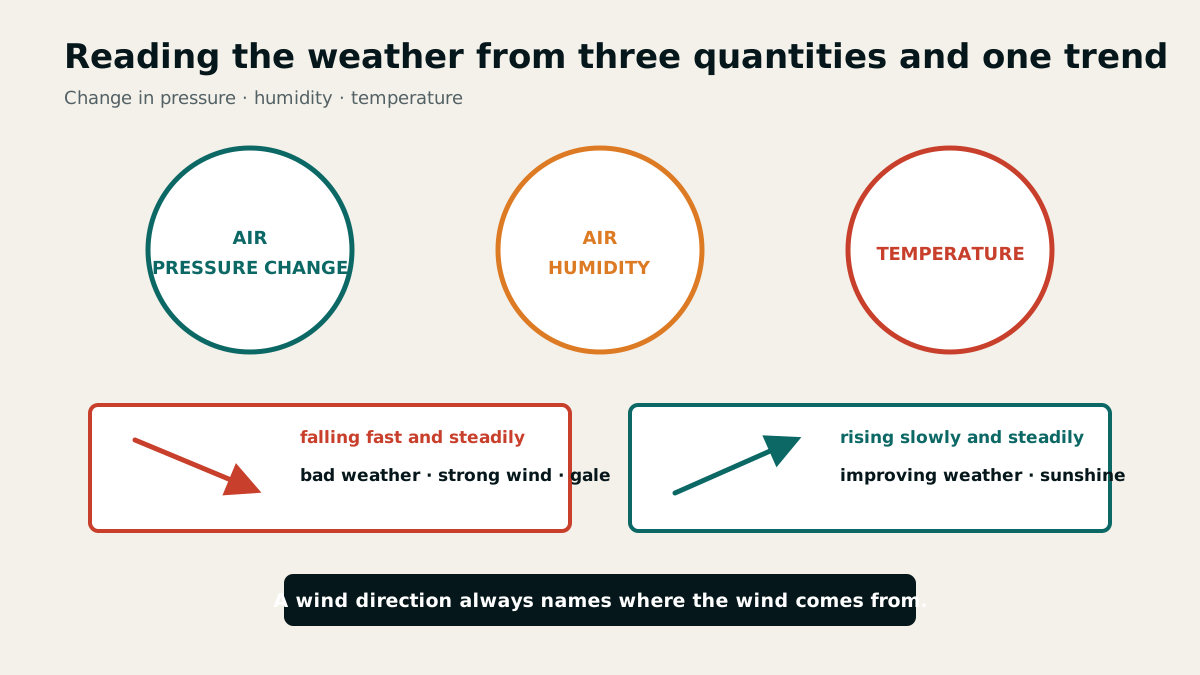
Three factors govern wind and precipitation: the change in air pressure, the humidity and the temperature. Not the pressure itself — its change.
From this follows the rule that matters most in practice on board:
- Pressure falling fast and steadily — bad weather, strong winds or a gale.
- Pressure rising slowly but steadily — better weather, sunshine.
Rapidly falling pressure means bad weather, strong winds or a gale are to be expected; a slow steady rise points to better weather. These trends are judged together with the other weather observations.
Restricted visibility
Restricted visibility arises from fog, snowfall and heavy rain — three causes the exam expects as a list.
If it sets in during a passage, on certain waterways the passage must be broken off without delay where radar and radiotelephony are lacking. A radar passage is accordingly defined as a passage in restricted visibility with radar.
A radar reflector on a recreational craft conversely makes you easier to detect on other vessels' radar screens. A plastic hull under sail throws almost no echo — the reflector is what makes you visible to a cargo ship in fog at all.
Water-skiing and visibility
On the stretches where it is allowed, water-skiing is permitted only from sunrise to sunset and with a visibility of 1,000 metres and more. Two conditions, and both are asked about.
Chapter 9 · 25 questions
Engine, propeller and liquefied gas
Twenty-five questions on the machinery — and a third of them turn on a single peculiarity: a propeller does not only push, it also pulls the stern sideways.
Direction of rotation and the paddle-wheel effect
The direction of rotation is always determined looking from aft, going ahead. Right-handed means clockwise, left-handed anticlockwise.
The paddle-wheel effect — the propeller's indirect steering action — is the sideways displacement of the stern. It arises because the screw does not only push against the water but also bears on it.
With a right-handed propeller the stern goes to port when going astern. That is precisely why the port side is the side to recommend for coming alongside: when you stop her by going astern, the paddle-wheel effect draws the vessel onto the quay instead of pushing her off.
Knowing the direction of rotation helps in manoeuvring — that is the short exam answer, and it describes exactly this connection.
For an electric motor, the common basic question gives the limit for commanding without a licence as 7.5 kW at most in duty type S1 (continuous operation). What counts is this continuous rating, not a brief peak output.
Steering action
A rudder blade works only when water flows past it. Two exam answers follow from that:
- With an inboard engine on a fixed shaft, steering action when going astern sets in comparatively late — it begins only once water flows against the rudder blade.
- A vessel with an outboard motor and no rudder obtains her steering action from the propeller race and the direction of the propeller — the motor swings with it and directs the stream.
You come alongside against the current and the wind where possible, because the vessel can then be manoeuvred more safely: both slow her down, and what slows her down can be metered.
What to keep an eye on
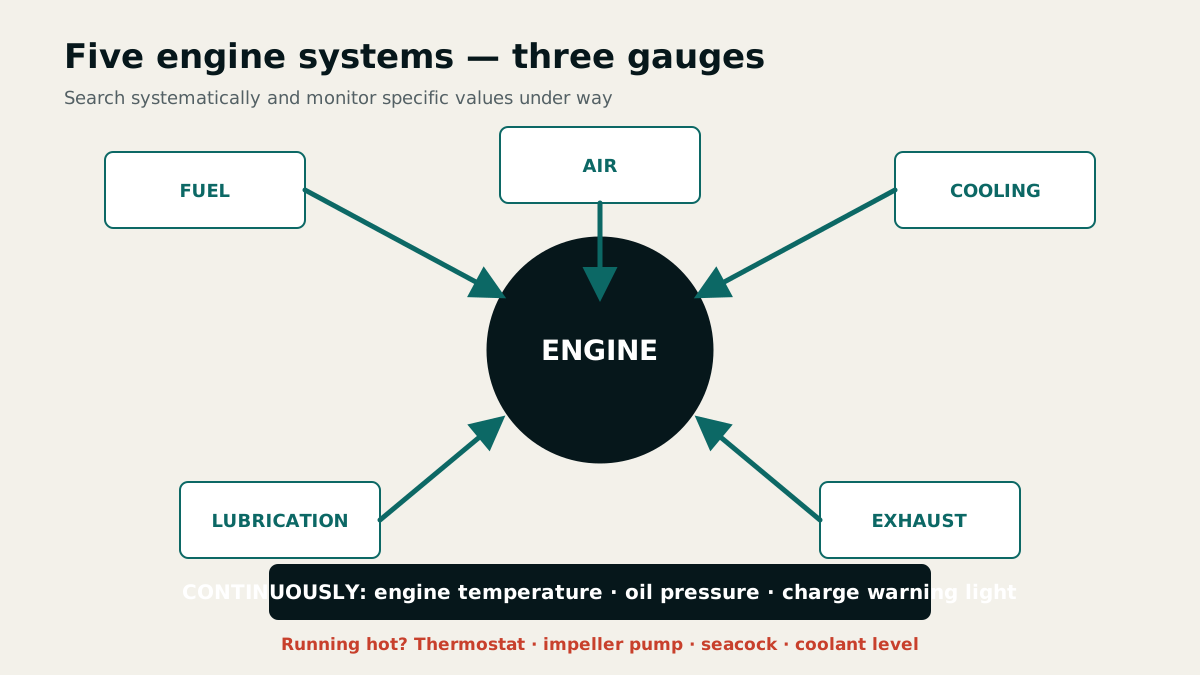
Three things want watching continuously under way: engine temperature, oil pressure, charge warning light. Three gauges, three fault patterns — and the exam asks about each separately:
- Temperature too high — a defective thermostat, a defective impeller pump, a closed seacock, too low a coolant level. All four causes concern the cooling.
- Charge warning light does not go out — the alternator or its regulator is defective.
- Oil warning light stays on — the pressure switch or the oil pump is defective.
Two further fault patterns: if the engine stops on engaging the gear, the propeller is fouled. If an outboard with a full tank stops under way, the vent screw is closed or the fuel line is blocked — in both cases no fuel is getting through.
The kill cord — the lanyard round the wrist — brings about the interruption of the ignition circuit or of the fuel supply. If the driver goes overboard, the engine stops.
Refuelling and leaving the boat
Four rules govern refuelling, and all four aim at the same thing: no spark, no overflow.
- stop the engine
- operate no electrical switches
- make preparation against fuel overflowing
- no naked flame
If fuel or oil gets into the bilge, it is taken up with rags and disposed of in an environmentally sound way — not pumped out. The bilge pump would carry it into the water.
For leaving the vessel for any length of time: close all seacocks and switch off the main battery switch. Two movements of the hand against flooding and against a cable fire.
Liquefied gas: heavier than air
Propane and butane are particularly dangerous on board because they are heavier than air and form an explosive mixture with it. Escaping gas does not rise and disperse — it sinks into the bilge and stays there.
The whole of the regulation follows from that single property:
- Storage on deck where possible, protected from direct sunlight — otherwise in a specially closed compartment for gas containers having an opening to the outside at floor level. Exactly where the heavy gas sinks to.
- Before putting into service: the installation must have been inspected and approved, pipes and connections tight; the main cock and the shut-off valves are then opened.
- Taking out of service: close the main cock and the shut-off valves.
If gas has got inside the boat: shut off the gas supply and provide ventilation — and while doing so operate no electrical switches and use no radio and no mobile telephone. Any switching spark can ignite it.
Chapter 10 · 24 questions
Manoeuvres, anchoring and damage to the rig
Twenty-four questions on practice: how to overtake, anchor and lock through — and what to do when something in the rig gives way. What counts here is not the system but the right first action.
When a vessel is under way
A vessel is under way when she is neither at anchor, nor made fast to the shore, nor aground. She need not be moving — a drifting boat is under way.
The definition carries further than it looks: what lights and shapes are to be carried hangs on it.
Close to large vessels
Three questions treat the same danger from three angles — suction, wash and bow wave.
Come close to a large vessel under way and you may capsize in her bow or stern wave or collide with her through her suction.
If you are overtaken by a larger vessel, the bow wave, suction or wash can take you off course, cause a collision, make you broach or put you aground in shallow water.
When meeting in a narrow fairway it follows accordingly: reduce speed and keep a sufficient passing distance.
Overtaking and giving way
An overtaking manoeuvre is carried out briskly, without impeding the vessels involved, with regard to the traffic situation and to any sound signals, and at a sufficient distance.
Give-way manoeuvres must be timely, readily apparent and decisive. Those three words are the answer, and they describe exactly the opposite of what the inexperienced do: late, hesitant and in small steps. The other vessel must be able to see that you are giving way.
A red pennant marks a vessel to which the competent authority has granted priority of passage through places where an order is laid down. That is an official grant of priority and not a general right of way at every meeting place.

Anchoring
Two signs tell you whether the anchor is holding: with a hand laid on the chain or warp there is no snatching, and the anchor bearing does not change. If it snatches, the anchor is dragging over the ground.
In canals anchoring is prohibited — pipes and cables lie in the bed there.
Anchors that may obstruct navigation are marked by day with a yellow anchor buoy — a float over the anchor, so that nobody runs over it.
Coming alongside and locking through
The best approach angle when coming alongside is as shallow as possible. Come in at a slant, not head on.
When several small craft lock through from the upper to the lower reach there are two things to watch. The last small craft must enter far enough not to come down on the sill as the lock empties. And the mooring lines are to be handled so that knocks against the lock walls, the gates and other vessels are avoided and safe surging remains possible.
Car tyres as fenders are prohibited in locks: they are not buoyant and, if they come adrift, can cause considerable trouble in the lock.
Keeping ropes and sails in order
Ropes are coiled down properly so that they run clear when needed. With halyards a second reason is added: so that they can be surged quickly and safely — a fouled halyard in a gale is an emergency.
Small damage to the sails is likewise repaired at once, because under the pressure of the wind it quickly becomes large. A two-centimetre tear is half a sail after one squall.
When something breaks
Three questions treat damage to the rig, and the answers follow one common idea: take the load off the damaged part.
- The windward shroud parts on the wind — tack. The mast is then taking its load on the sound side.
- The forestay parts under mainsail on the wind — bear away onto a run. The pressure of the wind then pushes the mast aft instead of forward.
- A parted forestay can be replaced temporarily by the jib or a halyard.
An accidental gybe is dangerous because it can lead to injury to the crew, damage to the rig and capsize.
If a dinghy capsizes and cannot be righted again: first check that the crew is complete and give assistance where needed, then hold on to the boat or lie on it and wait for help. The boat floats; whoever swims away loses it.
Gale warning and refuse
On a gale warning on a larger body of water: put on a lifejacket, hand the sails, and try to make a harbour or a sheltered bay. The order is the answer — secure yourselves first, then act.
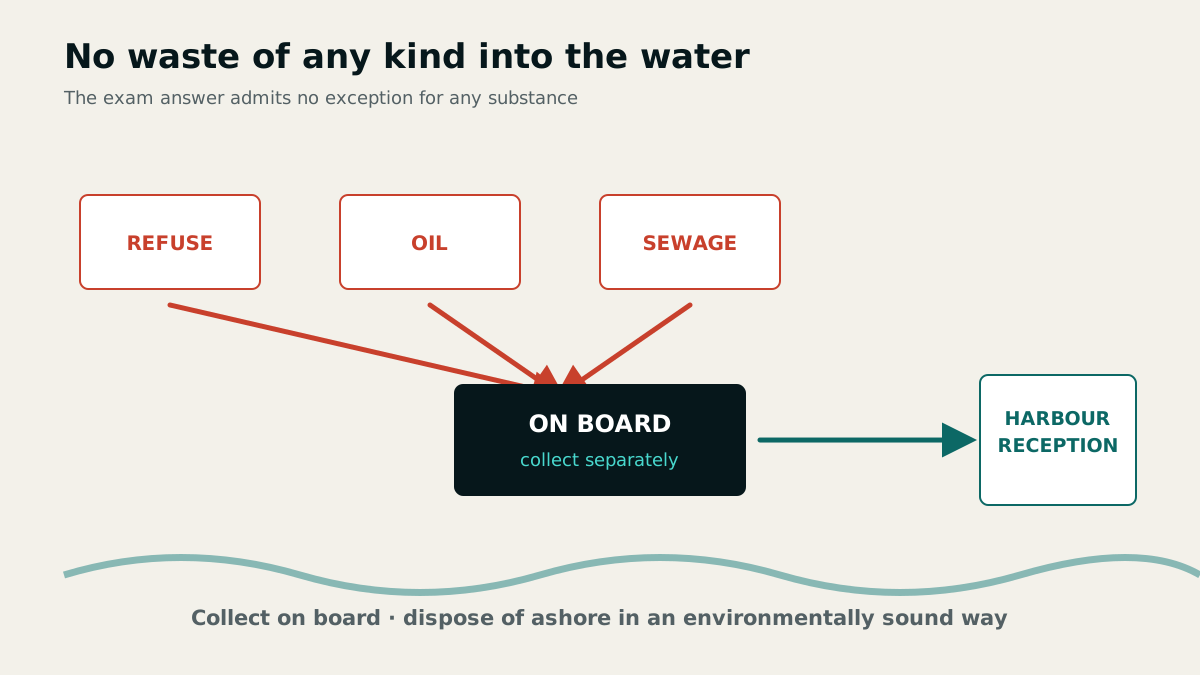
Refuse of every kind is collected on board and disposed of ashore in the appropriate containers in an environmentally sound way. Nothing goes over the side.

Chapter 11 · 5 questions
Safety on board
Five questions, and four of them turn on numbers and sequences that count when it matters.
Two years, twice over
Two servicing intervals are asked about, and they are fortunately the same:
- Inflatable lifesaving equipment — as the manufacturer specifies, at least every 2 years.
- Fire extinguishers — have them inspected at least every 2 years.
Suitable for recreational craft are ABC dry powder and foam extinguishers.
Fighting a fire properly
Three measures, and the order is the answer:
- Cut off the air supply — hatches and flaps shut, take the oxygen from the fire.
- Use the extinguisher only at the seat of the fire, not already on the way there. An extinguisher is empty in seconds.
- Fight the fire from below where possible — where it is burning, not where the flames are.
When distress signals are permitted
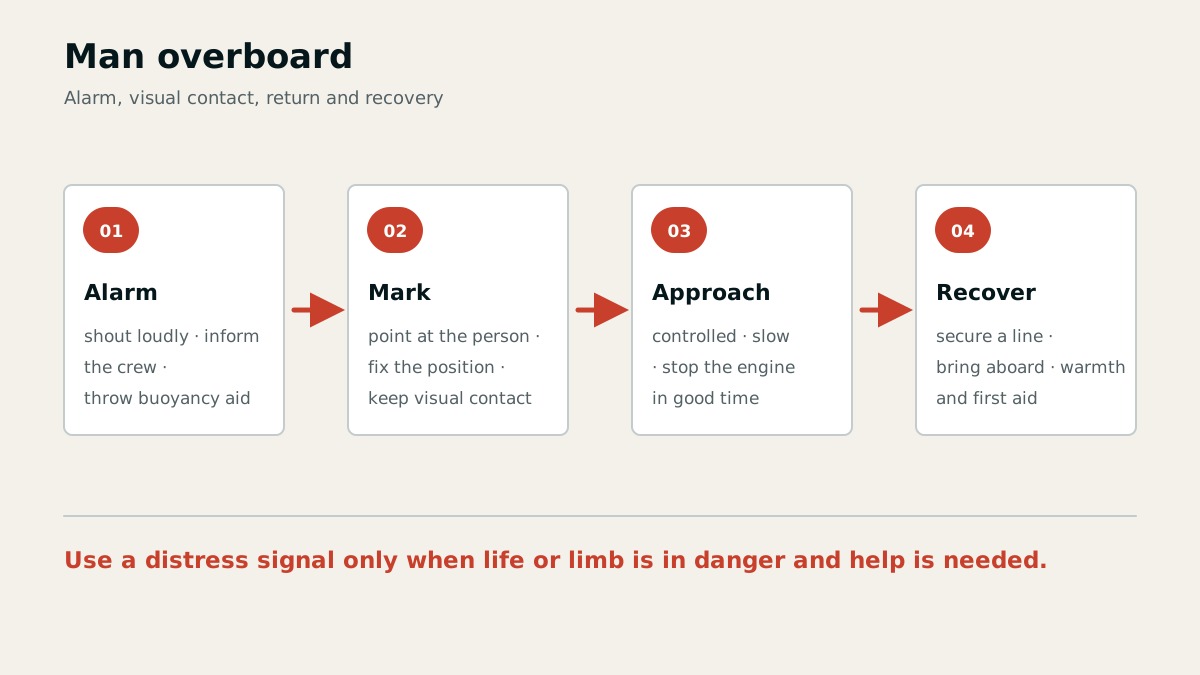
Distress signals may be given when there is danger to life or limb of persons and help is therefore needed. The same definition as for the distress signal certificate — it is about people, not about the boat.
Where all this can be read up
Rules and tips for water sports enthusiasts, recommendations on equipment and guidance on environmentally sound conduct are given in the nautical publications “Sicherheit auf dem Wasser” and “Sicher auf See”.
Chapter 12 · 5 questions
The environment
Consideration for nature and the environment belongs to every passage. What counts is avoidable damage, protected areas and the right handling of refuse.
The ten golden rules
The leaflet with guidance on protecting rare animals and plants and on keeping the water clean is called “The 10 Golden Rules for Water Sports Enthusiasts”.
And the question of how the living conditions of plants and animals can be preserved has the same answer: by environmentally aware conduct and by observing those same ten golden rules. Two questions, one document.
Paints and antifouling
Information on environmentally friendly paints, varnishes and antifouling coatings is available from the Federal Environment Agency.
This fits what the chapter on sailing says: when the old underwater coating is removed, the waste is hazardous waste. Antifouling works by being poisonous — which is why it belongs neither in the water nor in household refuse.
Keep your distance, leave nothing behind
You keep as far as you can from reed and rush beds and from densely vegetated shorelines, because they are frequently resting and breeding places for birds particularly worth protecting or fish spawning grounds. There the boat disturbs not by noise but by its mere presence.
For disposal one rule admits no exception: no refuse whatever may reach the water. Sewage and oils are to be disposed of ashore.