
Study guide · SBF See
Inland and Coastal Powerboat Licence (Sea)
The official catalogue contains two hundred and eighty-five questions. This study guide explains the material behind them — and shows where the questions follow a system that can be understood rather than memorised.
The captions under the picture boards keep the official German wording of the examination answers. The examination is held in German, and that exact wording is what counts in it.
Chapter 1 · 9 questions
Law and responsibility
Being in command means responsibility: for the crew, for a safe passage and for compliance with the rules. This is where you place the legal foundations.
Who commands and who answers for it
If it is not settled before departure who the master is, a master responsible for the vessel must be appointed. Responsibility for complying with the traffic rules rests with the person in charge of the vessel or a deputy.
No one may command the vessel or independently determine her course or speed who is impaired in safe command by physical or mental deficiency or by alcohol or other intoxicants — or who has a blood alcohol level of 0.5 per mille or more.
When a licence is required
On maritime waterways a licence is required to command a recreational craft with more than 11.03 kW (15 hp) of usable power. For an electric motor the limit is 7.5 kW in duty type S1, that is in continuous operation.
The exam asks about the exception: exempt are recreational craft without propulsion machinery and those whose greatest usable power, which cannot be exceeded, stays within these values.
The same figures as on inland waterways. Anyone taking both licences need learn them only once.
What a fairway is
Under the SeeSchStrO and the EmsSchO, fairways are those areas of water bounded or marked throughout by lateral marks — and, inland of the river mouths, also unmarked areas of water intended for through traffic.
The second half of the sentence is the important one: not every fairway is buoyed.
Water-skiing, personal watercraft, sailboards
These are permitted outside the fairway, provided the GDWS has not prohibited them by public notice. Within the fairway only on stretches published by the GDWS or marked by blue boards bearing the white symbol of a water-skier, a personal watercraft or a sailboarder.
Off places with visible bathing activity — outside the fairway and within 500 m of the shore — a maximum speed of 4.3 knots applies.
In designated permitted zones, particular water sports craft may be allowed. High-speed corridors under the North Sea Navigation Ordinance, by contrast, are designated areas of water for commercial traffic — not for you.
Chapter 2 · 79 questions
Marks, lights and visual signals
Navigation marks follow a clear system of shape, colour and position. Understand it and you can place many marks instead of learning each one by heart.
The sentence from which everything follows
A single definition settles half this chapter: the starboard side of a fairway is — except in the Wadden Sea — the side that a vessel coming in from seaward has on her starboard side.
The sides therefore do not depend on where you are going but on the direction inward from seaward. Going out, you have the “starboard side of the fairway” to port. Several exam questions aim at exactly this.
Compare it with inland waters and the same principle appears in different dress: there, right and left hang on the river; here they hang on the direction from seaward. In both cases the marking is fixed to the place, not to the boat.
The lateral system: green to the right, red to the left
The whole of the fairway buoyage follows from that definition:
- Starboard side — green, a conical buoy with a cone topmark. Its light is green: flashing, quick flashing or group occulting.
- Port side — red, a can buoy with a cylinder topmark. Its light is red, with the same kinds of character.
At a junction two special forms are added that say both things at once: one buoy can mark the starboard side of the main channel and at the same time the port side of the branch — and the other way round. The basic colour says which channel is the preferred one.
The centre of a shipping route — the landfall buoy — carries a mark of its own. It marks not a side but the axis.


The cardinal system: the compass point tells you which side to pass
Cardinal marks mark a general danger — and their compass point says on which side you pass safely. A north mark means: pass to the north of it. A west mark: pass to the west.
That is the whole rule. The exam asks it eight times — four times for the day mark, four times for the light character — but the information is always the same: the direction in the name is the side on which you pass.
The pattern is easiest remembered from a clock face: the number of quick flashes follows the dial. East stands at three o'clock, south at six, west at nine — and each light gives that many flashes before it goes on. North flashes continuously, because twelve o'clock runs through the top.


Isolated danger: passable on every side
An isolated danger mark stands directly over a danger of limited extent — a wreck, a rock — with clear water all round. It can therefore be passed on every side.
Its light carries the character Fl. (2) — two flashes in the group. Two flashes, two black spheres as the topmark: the number repeats itself in the picture.

The light characters — four cases, one comparison
Every kind of character differs in a single question: how does the duration of light compare with the duration of darkness?
- Isophase — light and darkness of equal length.
- Occulting — the light is longer than the darkness.
- Long-flashing — light shorter than darkness, the flash lasting at least 2 seconds.
- Flashing — light shorter than darkness, the flash less than 2 seconds.
Long-flashing and flashing therefore differ only at the two-second boundary. That is the only number needed here.
The period of a light is the interval from the beginning of one complete character to the beginning of the next identical one — the length of one full cycle, that is.
A quick flashing light, finally, is defined by its frequency: 50 to 60 flashes per minute. It is the fastest of the lights and is therefore reserved for the cardinal marks.
A character such as “Oc (2) R. Whis.” then reads itself: occulting, in groups of two, red, whistle buoy.
Leading lights, transit lights and cross-bearing lights
Three kinds of light help you steer, and they are readily confused:
- Leading light — a sector light marking a fairway. You navigate by keeping to the right-hand side of the white sector in the direction of travel.
- Transit lights — a front and a rear light that are to be brought into line. When they stand vertically one above the other, you are on the line.
- Cross-bearing light — a sector light indicating an alteration of course. The alteration is made at the transition from the warning sector into the alteration sector.
The difference in one sentence: the leading light says where the fairway is, the transit lights say whether you are on the line, the cross-bearing light says when you must turn.
Day shapes: what a vessel says about herself
By day, vessels show by balls, cones, cylinders and diamonds what condition they are in. The exam asks about five conditions separately: not under command, restricted in her ability to manoeuvre, aground, constrained by her draught and engaged in fishing.
A sailing vessel also being propelled by machinery carries in addition a black cone, point down — the same rule as on inland waters and with the same consequence: she then counts as a power-driven vessel.
If every vessel of a towing convoy carries a black diamond, the convoy is more than 200 metres long.
With dredgers and vessels restricted in their ability to manoeuvre, the arrangement tells you where to pass: on the side showing two black diamonds one above the other, or two green all-round lights one above the other. If the vessel is making way through the water and is not obstructing, you pass on the side lying to the right in the direction of travel.


Boards: what carries over from inland waters
Some of the boards are identical with those of the SBF Binnen — they apply on maritime waterways too. No overtaking, no passing, anchoring and mooring prohibited, suction and wash, obligation to stop, end of the stretch, no entry.
Two signs have a meaning of their own at sea that has to be known:
- The speed board here means speed through the water in km/h — on the Kiel Canal, by contrast, over the ground.
- A separate board limits speed on account of bathing to 8 km/h through the water within 500 m of the shoreline. Another closes areas to all power-driven vessels and personal watercraft, likewise on account of bathing.


Closures, warning areas and where anchoring is allowed
Several signs close or warn: prohibited area, permanent closure of the maritime waterway with passage prohibited, exceptional obstruction to navigation. A flag signal means simply stop.
Military warning areas closed for firing practice are recognised by particular day and night signals under the GDWS Prohibited and Warning Areas Ordinance — shown at signal stations and on guard vessels. If flares with white stars are fired, they come from the armed forces, the federal police or a vessel towing targets: you keep clear.
A public service vessel engaged on duty may depart from the traffic rules — a sign telling you that the usual expectations do not hold there.
For anchoring, section 32 of the SeeSchStrO separates two levels. Within the fairway anchoring is prohibited — except in the roadsteads and for vessels restricted in their ability to manoeuvre.
Outside the fairway anchoring is prohibited at these places:
- at narrows and in blind bends
- within 300 m of floating plant, wrecks and other obstructions to navigation
- in restricted visibility, less than 300 m from overhead power lines
- 100 m above and below barrages
- off harbour entrances, landing stages, locks and sluices, and in the approaches to the Kiel Canal
- within ferry and bridge sections
- at places published under section 60
The anchoring prohibition sign closes 300 m on either side of the line joining its boards; where distances or stretches are given with it, these apply instead of the 300 m. Using the anchor for manoeuvring purposes does not count as anchoring — but even that is forbidden in the vicinity of obstructions and barrages. Whoever anchors must keep an anchor watch; vessels under 12 m are exempt on certain waters.


Distress signals
Annex IV to the COLREGs lists fifteen distress signals. Grouped by the sense with which you perceive them, they stick better than in an arbitrary order.
To be seen:
- a red parachute flare or a red hand flare
- rockets or shells throwing red stars at short intervals
- an orange smoke signal
- flames on the vessel, from a burning tar barrel for instance
- the flag signal NC of the International Code of Signals
- a square flag with a ball above or below it
- slow, repeated raising and lowering of the arms outstretched to each side
To be heard:
- gun or explosive signals at intervals of about a minute
- continuous sounding of a fog-signalling apparatus
Transmitted:
- the Morse signal SOS — ··· ——— ··· — by light or sound
- the spoken word Mayday by radiotelephony
- a DSC distress alert, on VHF channel 70
- signals from an emergency position-indicating radio beacon (EPIRB)
- approved radio signals, from a search and rescue transponder (SART) for instance
- an Inmarsat distress alert
The flag signal NC means on its own: vessel in distress. And in practice the radiotelephone call begins with “Mayday” three times — that is the form of the call under the radio regulations, not the distress signal of Annex IV.

Where to look everything up
Five questions test whether you know the official publications:
- Information about the area comes from nautical charts, the List of Lights, sailing directions, tide tables or calendars, the radio service for small craft and leisure boating, Notices to Mariners (NfS) and Announcements to Mariners (BfS).
- NfS and BfS carry every change to buoyage, lights, wrecks and shoals, together with other measures and events.
- Symbols, abbreviations and terms of German nautical charts are given in INT1 / Chart 1.
- Descriptions of the navigation marks, their lights and signal stations: the List of Lights, sailing directions and nautical charts.
Which regulations govern the equipment and fitting of navigation lights, day shapes and sound signalling appliances is a question of its own: the COLREGs, the SeeSchStrO and the Ems Estuary Navigation Regulations (EmsSchO). On German recreational craft only types approved by the BSH, or holding an equivalent EU approval, may be used.
Local special provisions are given in the public notices of the GDWS.
Chapter 3 · 29 questions
Lights
Twenty-nine questions, and what keeps them apart is four numbers: 7, 12, 50 and 100 metres. The length of the vessel decides how many lights she carries.
When and what for
Lights are carried from sunset to sunrise and in restricted visibility. They show a vessel's direction of travel and position — the same two answers as on inland waters.
The basic lights are the same as well: the masthead light white and forward, the sidelights red to port and green to starboard, the sternlight white and aft.
The length thresholds
Four numbers govern the lights to be carried, and the exam asks about each of them separately:
- 50 m — from this length a power-driven vessel must carry the second, higher masthead light abaft the first. Under 50 m it is permitted but not required. A vessel at anchor under 50 m may carry a single white all-round light; from 50 m there are two, forward and aft.
- 200 m length of tow — beyond it, three masthead lights in a vertical line are prescribed on the towing vessel instead of two, together with diamond shapes.
- 100 m — vessels at anchor must also light their decks.
- 12 m and 7 m — these concern the relaxations for small vessels.
Two masthead lights offset fore and aft point to a larger power-driven vessel in the exam illustrations. They do not prove her length in every case, because the second light may be carried voluntarily under 50 m. Towing lights arranged in a vertical line are to be distinguished from these.


What the condition changes
Beyond the basic lights, a vessel shows by all-round lights what condition she is in — the same conditions as the shapes by day:
- Not under command, 12 m and over: two red all-round lights in a vertical line. If she is also making way through the water, sidelights and a sternlight are added.
- Restricted in her ability to manoeuvre, aground, constrained by her draught and engaged in fishing each have combinations of their own, shown in the table below.
For a vessel not under command, added sidelights and a sternlight show that she is making way through the water. This cannot be carried over to every type of vessel: a power-driven vessel under way carries her running lights even when she is making no way through the water at that moment.


Small vessels
Relaxations apply to small vessels, and they are tied to lengths:
- Sailing vessel under 20 m — may carry a tricolour lantern at or near the masthead instead of sidelights and sternlight.
- Sailing vessel under 12 m, or a vessel under oars, that cannot carry the prescribed lights — one white all-round light.
- Power-driven vessel under 7 m that cannot carry the prescribed lights — she must not proceed during the hours when lights are required, except in an emergency.
Sailing vessels, rowing boats and vessels being towed carry only sidelights and a white sternlight — no masthead light. That is the quickest way to tell a sailing vessel from a motor boat at night.
As soon as a sailing vessel is also being propelled by machinery, she carries the lights of a power-driven vessel.
A vessel at anchor under 50 m carries one white all-round light where it can best be seen.
Locks and the Kiel Canal
At a lock the lights mean what they mean on inland waters: the combination shown means entry clear, opposing traffic stopped.
The Kiel Canal has signals of its own. Recreational craft may enter the locks when a white flashing light is shown. Three flashing red lights one above the other on a siding signal mast mean: departure prohibited for all vessels — you must wait for the signal to be lifted.
A Morse signal made by light or sound may also be a distress signal.


Chapter 4 · 23 questions
Sound signals
At sea the sounds do not say where you want to go but what you are doing — and in fog, what kind of vessel you are.
Two lengths, as on inland waters
The definitions are the same: a short blast lasts about one second, a prolonged blast about four to six seconds.
The difference lies in the meaning. On inland waters a short blast says “starboard” — at sea the signals announce your own manoeuvre and, in fog, your own condition.


Manoeuvring signals
Three signals announce what you are doing:
- One short blast — I am altering my course to starboard.
- Two short blasts — altering course to port.
- Three short blasts — my engines are going astern.
At least five short blasts draw the attention of a give-way vessel to her obligation to keep out of the way — the same signal with which the stand-on vessel warns before taking action in extremis.
On entering a fairway or a harbour, one prolonged blast is sounded when the traffic situation calls for it.

The general danger and warning signal
It consists of two groups, each of one prolonged and four short blasts, and is to be given when a vessel endangers another or is herself endangered by it.
It is therefore something other than the five short blasts: the five say “you must keep out of the way”, the danger and warning signal says “this is becoming dangerous”.

Fog signals: what you hear tells you what is there
In restricted visibility the following whistle signals identify the type of vessel and her state of movement. They are given at least every two minutes; vessels at anchor have signals and intervals of their own.
- One prolonged blast — power-driven vessel making way through the water.
- Two prolonged blasts — power-driven vessel under way but stopped, making no way through the water.
- Prolonged, short, short — not under command, restricted in her ability to manoeuvre, constrained by her draught, sailing vessel, and vessels towing or pushing or engaged in fishing. The signal alone creates no blanket obligation to keep out of the way; in restricted visibility the conduct rules provided for that situation apply.
- Prolonged, short, short, short — immediately after the preceding signal: the vessel being towed, or the last manned vessel of a towing convoy.
A sailing vessel of 12 m and over therefore sounds prolonged, short, short at least every two minutes. A vessel under 12 m that cannot give the prescribed signals sounds, at least every two minutes, some other efficient sound signal that cannot be mistaken for the prescribed ones.


At anchor in fog
At anchor you do not whistle, you ring — and the length of the vessel decides:
- Under 100 m — the bell rung rapidly for about 5 seconds, at least every minute.
- 100 m and over — the same ringing, followed immediately by the gong sounded rapidly for about 5 seconds.
In addition, any vessel at anchor may sound short, prolonged, short on the whistle to give an approaching vessel warning of her position. The same signal also warns of a dangerously close approach.


Conduct in restricted visibility
Four measures are to be taken in restricted visibility, and the exam expects all four: proceed at a safe speed adapted to the visibility, sound signals, switch on the navigation lights and keep a proper lookout.
If you hear the signal of another vessel apparently forward of the beam, a fixed sequence applies: sound a signal yourself, reduce speed to the minimum at which she can be kept on her course, take all way off if necessary — and in every case navigate with extreme caution until the danger is over.
Signals from ashore
Three sound signals come not from vessels but from installations and authorities:
- A bridge, barrage or lock cannot be opened for the time being — break off the passage and wait for clearance.
- A police vessel is ordering you to stop.
- The maritime waterway is closed, further passage prohibited.
And the keep-away signal — a long continuous sound with short blasts mixed in: leave the danger area at once.


Chapter 5 · 49 questions
Steering rules and traffic separation schemes
The collision regulations tie together the lookout, a safe speed and correct conduct when vessels meet. What matters is to recognise the situation first and then apply the right rule.
Where the COLREGs apply — and where something else prevails
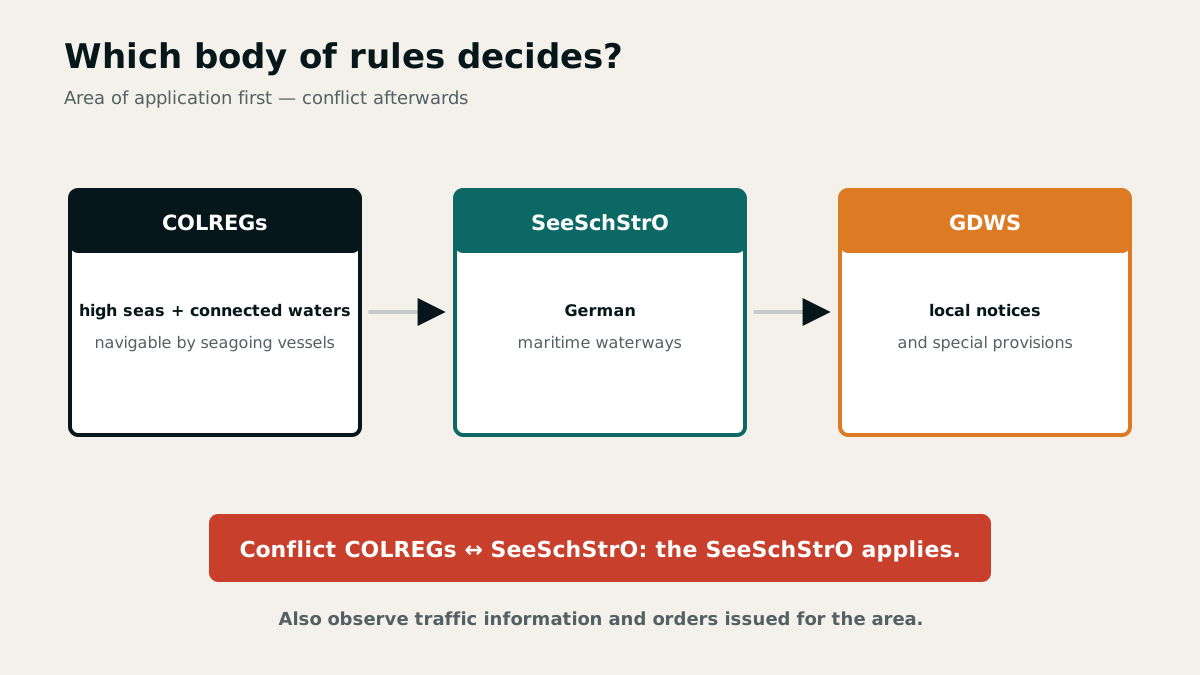
The collision regulations apply on the high seas and in all waters connected with them that are navigable by seagoing vessels.
On German maritime waterways the SeeSchStrO applies in addition. Where one of its provisions conflicts with the COLREGs, the SeeSchStrO prevails — the local rule takes precedence over the general one.
Which areas of water are maritime waterways at all is set out in the SeeSchStrO and in the Ems Estuary Navigation Regulations. For the Kiel Canal there are supplementary provisions in the SeeSchStrO and in the public notices of the GDWS.
Outside the fairway the rules of the COLREGs apply.
The order of precedence — seven questions, one ladder
For the encounter questions assigned here, the responsibilities of power-driven and sailing vessels help. The overview that follows applies together with the special rules, on overtaking and within a fairway for instance:
- Vessel not under command
- Vessel restricted in her ability to manoeuvre
- Vessel engaged in fishing
- Sailing vessel
- Power-driven vessel
A power-driven vessel keeps out of the way of vessels not under command, vessels restricted in their ability to manoeuvre, vessels engaged in fishing and sailing vessels. A sailing vessel keeps out of the way of vessels not under command, vessels restricted in their ability to manoeuvre and vessels engaged in fishing.
This overview is not a seamless ranking between all the types named. Check first whether overtaking, right of way in a fairway or an obligation not to impede applies; then apply the particular rule for that encounter.
Not under command, or restricted in her ability to manoeuvre?
The two highest ranks are readily confused, and the exam asks for both definitions separately:
- Not under command — through exceptional circumstances, a failure of the steering gear or the engine for instance. Something is broken.
- Restricted in her ability to manoeuvre — through the nature of her work. Nothing is broken; the vessel is working, dredging or laying cable for instance.
Both are therefore unable to manoeuvre as required and unable to keep out of the way of another vessel.
Power against power
Two basic cases between power-driven vessels, both of them short:
- Reciprocal or nearly reciprocal courses — each vessel alters her course to starboard.
- Crossing courses — the vessel which has the other on her starboard side keeps out of the way.
Between sailing vessels with the wind on the same side: the windward vessel keeps clear of the leeward one.
Stand-on vessel and give-way vessel
The roles are clearly allotted, and both carry duties.
The give-way vessel makes her manoeuvre early, substantially and readily apparent. Three words describing exactly the opposite of what the inexperienced do.
The stand-on vessel keeps her course and speed for the time being and pays particular attention to the give-way vessel. As soon as it becomes clear that the other is not taking appropriate action, the stand-on vessel may manoeuvre herself to avoid a collision — the manoeuvre of the second-to-last moment.
If a collision can no longer be avoided by the action of the give-way vessel alone, the stand-on vessel must take such action as will best aid to avoid it: the manoeuvre of the last moment. This duty does not forbid the earlier intervention already permitted.
Recognising the risk of collision
A risk of collision may exist when the distance is closing and the bearing does not change, or does not change appreciably.
The steady bearing is the warning sign, not the short distance. Two vessels can pass at a hundred metres without any risk — and be on a collision course at two nautical miles.
Two terms belong here. In sight of one another means that each vessel can observe the other visually — the steering rules of the COLREGs apply only then. And a safe speed is one adapted to the traffic situation and to the conditions of visibility and weather, at which the vessel can be stopped at any time.
Traffic separation schemes
A traffic separation scheme is a published shipping route divided into one-way traffic lanes by separation lines or separation zones. The rules for it are set out in the collision regulations.
You navigate only to the right of the separation line, in the general direction of traffic flow. Four points go with this:
- proceed in the appropriate traffic lane in the general direction of traffic flow
- keep clear of the separation zone as far as practicable
- as a rule join or leave the traffic lane at the ends
- joining or leaving from the side at as small an angle as practicable to the direction of traffic flow
Crossing is to be avoided as far as possible. If it must be done, then with the heading at right angles to the general direction of traffic flow — and that holds even when wind or current is setting the vessel sideways. It is not the course over the ground that should be at right angles but the heading: that way you are clear of the lane soonest and easiest for commercial traffic to judge.
Who must not impede within a separation scheme
A form of words applies here that must be kept apart from “keeping out of the way”: not to impede the safe passage. That is not an obligation to give way in the narrow sense but a duty not to get into the situation at all.
- Vessels under 20 m and sailing vessels must not impede the safe passage of a power-driven vessel following a traffic lane.
- A sailing vessel crossing must not impede the safe passage of a power-driven vessel following a traffic lane.
- The ordinary rule continues to apply the other way round: a power-driven vessel in a traffic lane keeps out of the way of a power-driven vessel crossing the lane from her starboard side.
Vessels constrained by their draught must likewise not be impeded in their safe passage.


In the fairway and when overtaking
Sailing vessels within a fairway that are not clearly following the direction of the fairway — beating, that is — keep out of one another's way under the rules of the COLREGs, provided that in doing so they neither endanger nor impede vessels having right of way.
A vessel is deemed to be overtaking when she is approaching another from a direction more than 22.5° abaft the beam — that is, from the sector of the sternlight. The definition is not arbitrary: it coincides exactly with the sector in which only the white sternlight is visible.
Overtaking is prohibited at narrows, in blind bends, in the vicinity of locks, on stretches marked by an overtaking prohibition sign and near ferries not running on a fixed line that are under way.
Towing boats for water-skiers, personal watercraft and sailboarders must keep out of the way when approaching other vessels — they stand, in practice, outside the order of precedence.
Close to large vessels
The same three forces as on inland waters, and the same answers. Come close to a large vessel under way and you may capsize in her bow or stern wave or collide through her suction.
If you are being overtaken, the bow wave, suction or wash can throw you off course, make you broach or, in shallow water, put you aground.
When meeting in a narrow fairway: reduce speed and keep a sufficient passing distance. Approaching moored vessels in a narrow waterway, you reduce speed because of suction and wash.
The seamanlike duty of care
The seamanlike duty of care is the obligation to observe, over and above the traffic rules, those precautions required by the ordinary practice of seamen or by the special circumstances of the case. It is why “I followed the rules” is not a complete defence at sea.
In restricted visibility concrete measures follow from it: make careful use of all navigational equipment, increase the visibility of your own vessel — radar reflector, AIS — and, in an area with shore-based radar advice, listen in to it on VHF.
After a collision: render assistance, remain at the scene until further assistance is no longer required, and exchange all the necessary particulars.
Overtaking, entering and poor visibility
An overtaking vessel must keep out of the way of the vessel being overtaken — without exception and regardless of the order of precedence.
Vessels entering a fairway, crossing it, turning within it or leaving their anchorages and berths must give way to vessels following the course of the fairway. Whoever is in the fairway has priority over whoever is coming into it.
If the stand-on vessel finds that the give-way vessel is not meeting her obligation and a collision is imminent, she sounds at least five short blasts and carries out the manoeuvre of the last moment — manoeuvring in the way that will best aid to avoid the collision.
Anyone without technical equipment for position-fixing in restricted visibility must act on the seamanlike duty of care: leave the fairway and, if possible, find shallow water and anchor. Where that is not possible, keep as far to starboard as is practicable within the fairway.
Chapter 6 · 16 questions
Navigation
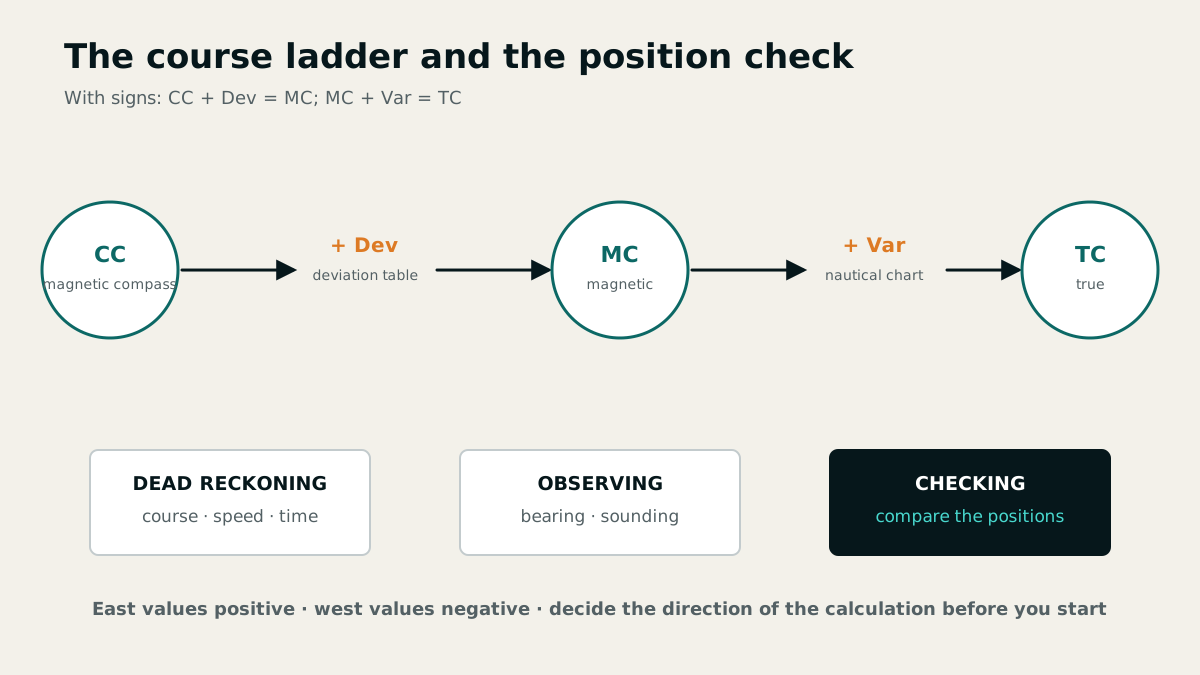
Sixteen questions on the art of knowing where you are. The exam asks for no calculation here — only the terms, and they build on one another.
The nautical mile and the knot
A nautical mile is the length of one minute of arc on a great circle of the earth — 1,852 metres. It is not an arbitrary unit but built into the earth itself: one minute of latitude, one nautical mile.
That determines where you take it off the chart: at the right or left margin, level with your position. Not at the top or bottom margin — those carry longitude, whose minutes vary in length with latitude.
A knot is accordingly the number of nautical miles covered in one hour.
Bearing and line of position
A bearing is the determination of the direction of a known fixed object by measuring an angle.
A line of position follows from it by plotting the true bearing on the chart. You are somewhere on that line — and two lines of position cross at your position.
The dead-reckoning position is the other route: a position established by calculation and by plotting from the courses steered, the distances run and every foreseeable influence. It says where you ought to be; the bearing says where you are.
Set caused by current and by wind
Current set and wind set share one definition in the exam: the displacement of the vessel over the ground in direction and distance.
Only the cause differs. Both make the course over the ground differ from the course steered — and both therefore belong in the dead-reckoning calculation.
The magnetic compass
Deviation is taken from the deviation table drawn up for that particular vessel. It is valid for this boat alone, because it depends on the iron on board.
Three rules govern installation: the lubber line must be parallel to the fore-and-aft line, the compass must be easy to read, and it must not stand near ironwork.
Charts and handbooks
German nautical charts give depths in metres and decimetres. Before using a chart you satisfy yourself that it has been corrected up to date — an uncorrected chart shows buoyage that no longer exists.
Information on coasts, harbours and natural conditions is found in the sailing directions and port handbooks.
Radio and AIS
Under section 3 of the SeeSchStrO, the master of a vessel fitted with a VHF radio is required to listen to and take account of the traffic information given by the vessel traffic service. If you carry a radio, you must also use it.
The Automatic Identification System (AIS) serves primarily to prevent collisions — not to navigate and not to fix a position.
If your own vessel has sunk and constitutes an obstruction to navigation, you inform the shipping police authority and give the position as far as you are able.
What AIS exchanges is vessel data — static and dynamic — together with voyage-related data.
Chapter 7 · 9 questions
Tides
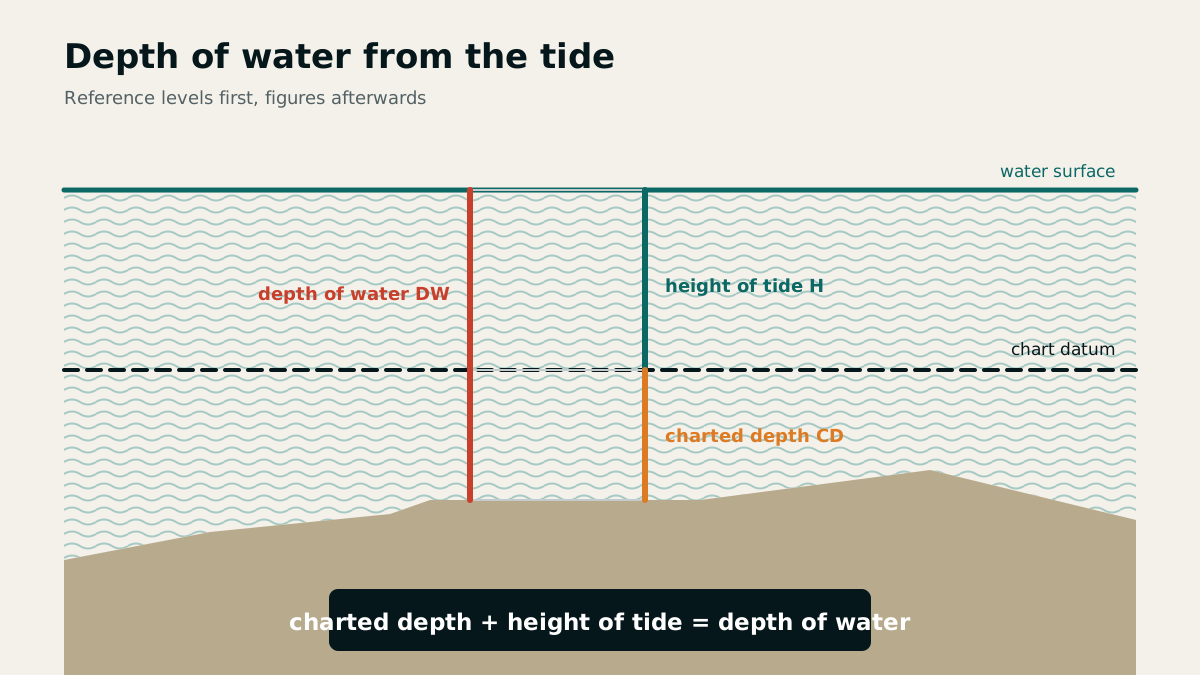
Nine questions, six of them definitions that need laying out side by side just once. After that they cannot be confused again.
The four terms in one row
Two denote a moment in time, two a process:
- Low water — a moment: the lowest water level at the turn from falling to rising.
- High water — a moment: the highest water level at the turn from rising to falling.
- Flood — a process: the rise from low water to the following high water.
- Ebb — a process: the fall from high water to the following low water.
This is where the commonest confusion sits: high water is not a state but an instant — and flood is not “a high water level” but the movement towards it.
Tide and tidal range
A tide is the period between one low water and the next — one complete cycle.
The tidal range is the difference between the heights of high and low water — a height, therefore, not a time.
The figures for a particular place are given in the tide tables or in the BSH tidal calendar.
Before using a nautical chart you must check that it has been corrected up to date. Current tidal data are no substitute for correcting the chart.
Where tides turn dangerous
In the tidal inlets between the islands, wind and an opposing tidal stream can act together and raise steep, rearing seas: breakers.
Wind against tidal stream in an inlet can raise steep, rearing seas and breakers. Whether it can be navigated must be judged from the conditions on the spot.
Chapter 8 · 15 questions
Weather and wind
Wind force, air pressure and weather warnings help you judge the situation. Keep the step on the Beaufort scale apart from the threshold at which a warning is issued.
Windward and leeward
Windward is the side facing the wind, leeward the side away from it. Leeward means a direction, not automatically calm air.
The Beaufort scale and the warning thresholds
The Beaufort scale gives wind forces from 0 to 12 together with their effect on the sea — not merely a speed but a picture from which the force can be read.
The exam asks for four steps by name:
- Fresh breeze — force 5
- Strong wind warning — force 6 and 7
- Gale warning — force 8 and above
- Storm 10, violent storm 11, hurricane 12
The threshold that matters for a recreational craft is 6: from there a warning is issued, and from there a small boat is seriously tested.
Air pressure and the weather chart
What governs wind and precipitation is the change in air pressure, the humidity and the temperature. When the pressure is falling rapidly, strong winds or a gale are to be expected.
On a weather chart, places of equal air pressure are joined by isobars; the unit is the hectopascal. How closely the isobars lie tells you how hard the wind blows — close lines mean a steep gradient.
The exam shows two charts: a high-pressure area in the northern hemisphere and a low with a warm and a cold front, each with isobars and pressure values in hPa.
In the station model shown, the shaft gives the direction the wind comes from: here north-west. In this exam illustration the barbs stand for force 3; the unfilled circle means cloudless. Wind direction, wind force and cloud cover are read separately.


Speed limits
Within the North Sea national parks, a power-driven vessel may not exceed 12 knots over the ground, save where the North Sea Navigation Ordinance provides otherwise.
Chapter 9 · 25 questions
Engine, propeller and liquefied gas
Twenty-five questions on the machinery — and a third of them turn on a single peculiarity: a propeller does not only push, it also pulls the stern sideways.
Direction of rotation and the paddle-wheel effect
The direction of rotation is always determined looking from aft, going ahead. Right-handed means clockwise, left-handed anticlockwise.
The paddle-wheel effect — the propeller's indirect steering action — is the sideways displacement of the stern. It arises because the screw does not only push against the water but also bears on it.
With a right-handed propeller the stern goes to port when going astern. That is precisely why the port side is the side to recommend for coming alongside: when you stop her by going astern, the paddle-wheel effect draws the vessel onto the quay instead of pushing her off.
Knowing the direction of rotation helps in manoeuvring — that is the short exam answer, and it describes exactly this connection.
For an electric motor, the common basic question gives the limit for commanding without a licence as 7.5 kW at most in duty type S1 (continuous operation). What counts is this continuous rating, not a brief peak output.
Steering action
A rudder blade works only when water flows past it. Two exam answers follow from that:
- With an inboard engine on a fixed shaft, steering action when going astern sets in comparatively late — it begins only once water flows against the rudder blade.
- A vessel with an outboard motor and no rudder obtains her steering action from the propeller race and the direction of the propeller — the motor swings with it and directs the stream.
You come alongside against the current and the wind where possible, because the vessel can then be manoeuvred more safely: both slow her down, and what slows her down can be metered.
What to keep an eye on
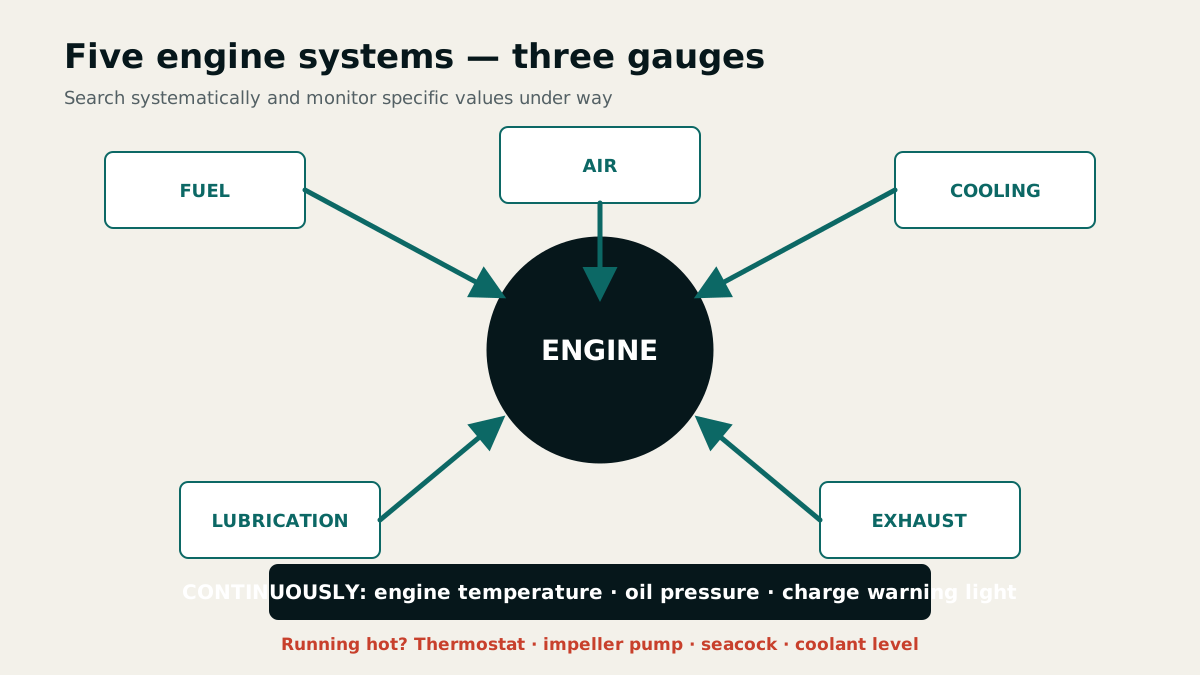
Three things want watching continuously under way: engine temperature, oil pressure, charge warning light. Three gauges, three fault patterns — and the exam asks about each separately:
- Temperature too high — a defective thermostat, a defective impeller pump, a closed seacock, too low a coolant level. All four causes concern the cooling.
- Charge warning light does not go out — the alternator or its regulator is defective.
- Oil warning light stays on — the pressure switch or the oil pump is defective.
Two further fault patterns: if the engine stops on engaging the gear, the propeller is fouled. If an outboard with a full tank stops under way, the vent screw is closed or the fuel line is blocked — in both cases no fuel is getting through.
The kill cord — the lanyard round the wrist — brings about the interruption of the ignition circuit or of the fuel supply. If the driver goes overboard, the engine stops.
Refuelling and leaving the boat
Four rules govern refuelling, and all four aim at the same thing: no spark, no overflow.
- stop the engine
- operate no electrical switches
- make preparation against fuel overflowing
- no naked flame
If fuel or oil gets into the bilge, it is taken up with rags and disposed of in an environmentally sound way — not pumped out. The bilge pump would carry it into the water.
For leaving the vessel for any length of time: close all seacocks and switch off the main battery switch. Two movements of the hand against flooding and against a cable fire.
Liquefied gas: heavier than air
Propane and butane are particularly dangerous on board because they are heavier than air and form an explosive mixture with it. Escaping gas does not rise and disperse — it sinks into the bilge and stays there.
The whole of the regulation follows from that single property:
- Storage on deck where possible, protected from direct sunlight — otherwise in a specially closed compartment for gas containers having an opening to the outside at floor level. Exactly where the heavy gas sinks to.
- Before putting into service: the installation must have been inspected and approved, pipes and connections tight; the main cock and the shut-off valves are then opened.
- Taking out of service: close the main cock and the shut-off valves.
If gas has got inside the boat: shut off the gas supply and provide ventilation — and while doing so operate no electrical switches and use no radio and no mobile telephone. Any switching spark can ignite it.
Chapter 10 · 7 questions
Manoeuvring and anchoring
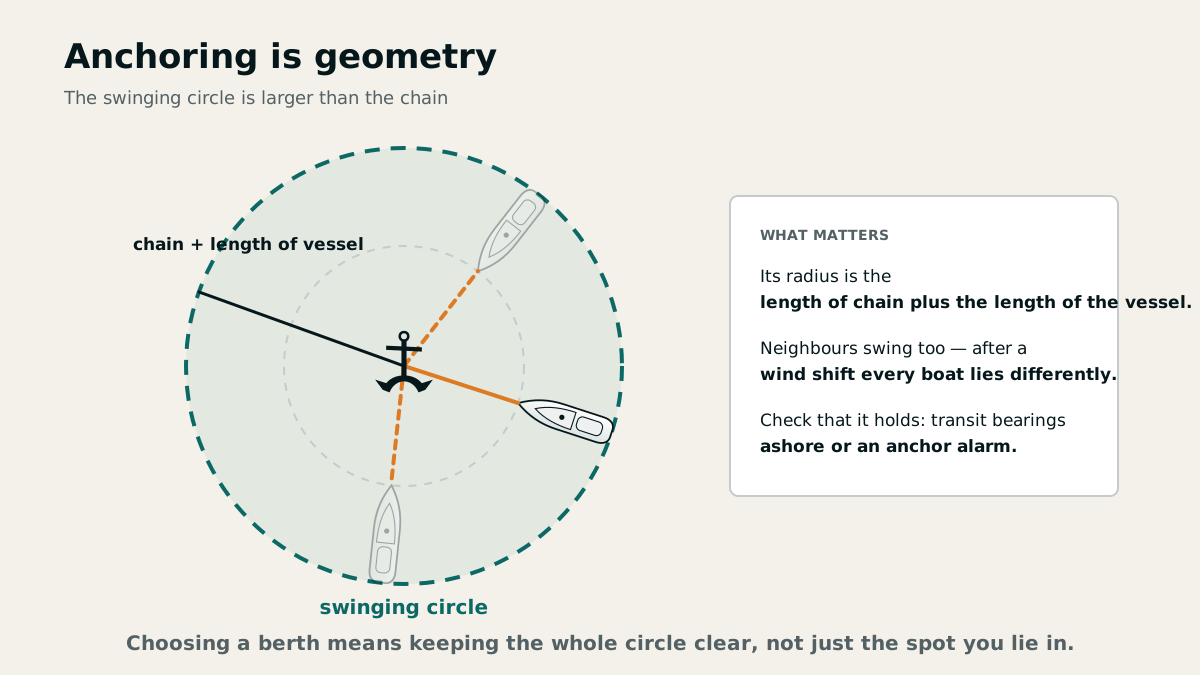
Manoeuvres need preparation and a clear order of steps. When anchoring, coming alongside and recovering someone, what counts is how boat, wind and water act on one another.
When a vessel is under way
A vessel is under way when she is neither at anchor, nor made fast to the shore, nor aground. She need not be moving — a drifting boat is under way.
The lights and shapes to be carried hang on this definition.
Coming alongside and anchoring
The best approach angle when coming alongside is as shallow as possible.
Two signs tell you whether the anchor is holding: with a hand laid on the chain or warp there is no snatching, and the anchor bearing does not change.
Towing and a heavy sea
Three rules govern towing a recreational craft: the towline is matched to the state of the sea, the towing speed must not exceed the speed the tow would make running free at displacement speed, and the line must not be brought up with a jerk.
In a heavy sea the towline should be at least two to three wave lengths long. Tug and tow then ride the same wave instead of working against each other.
A recreational craft that has lost steerage can be held bow to wind with a drogue or other suitable buoyant objects.
In a heavy sea you reduce speed to avoid damage from the seas coming aboard.
Chapter 11 · 5 questions
Safety on board
Five questions, and four of them turn on numbers and sequences that count when it matters.
Two years, twice over
Two servicing intervals are asked about, and they are fortunately the same:
- Inflatable lifesaving equipment — as the manufacturer specifies, at least every 2 years.
- Fire extinguishers — have them inspected at least every 2 years.
Suitable for recreational craft are ABC dry powder and foam extinguishers.
Fighting a fire properly
Three measures, and the order is the answer:
- Cut off the air supply — hatches and flaps shut, take the oxygen from the fire.
- Use the extinguisher only at the seat of the fire, not already on the way there. An extinguisher is empty in seconds.
- Fight the fire from below where possible — where it is burning, not where the flames are.
When distress signals are permitted
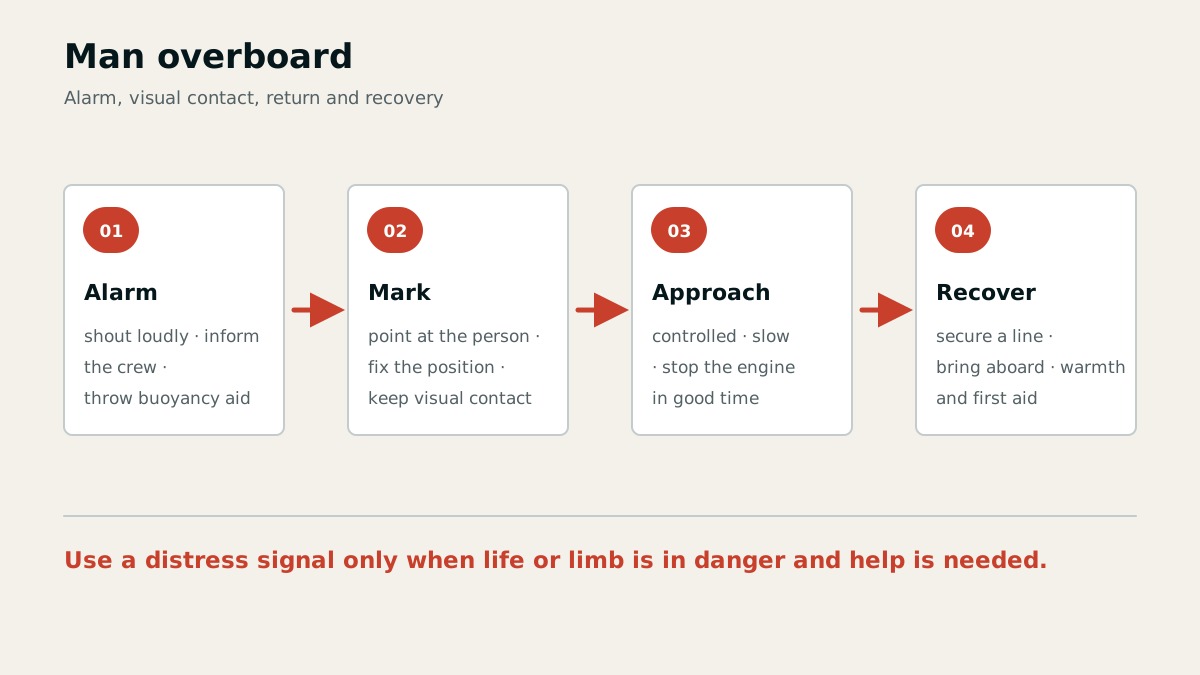
Distress signals may be given when there is danger to life or limb of persons and help is therefore needed. The same definition as for the distress signal certificate — it is about people, not about the boat.
Where all this can be read up
Rules and tips for water sports enthusiasts, recommendations on equipment and guidance on environmentally sound conduct are given in the nautical publications “Sicherheit auf dem Wasser” and “Sicher auf See”.
Chapter 12 · 8 questions
Distress and rescue
Distress and rescue begin with preparation. When it matters, what counts is a recognisable signal, timely help and the right rescue equipment.
Before letting go
The seamanlike duty of care carries with it a duty to brief the crew, and the exam asks about it in detail. Before setting out, the master must:
- instruct crew and guests in the safety precautions on board
- show them how to use the lifesaving and firefighting equipment
- point out suitable measures against falling overboard
- point out that a lifejacket worn at all times improves the chances of survival in the water
The last point is the most important and the one most often passed over: a lifejacket in the locker saves nobody.
Getting someone out of the water
The exam wants the aids listed: a line, a rescue sling, a recovery net, a tackle, a bathing ladder, the main boom.
The order makes practical sense — establish the connection first, then lift. A person in the water weighs more than you expect and after a short time can no longer climb unaided.
When the boat has capsized
Four instructions, and they run against the first impulse: stay with the vessel if you can, keep the crew together, avoid needless exertion and attract attention so that help can be given.
The boat floats and can be seen from a distance. A person in the water is neither.
The distress signals
A rocket showing a red star means distress at sea. The same applies to the flag signal NC and to the further signals listed in the chapter on marks and signals.
Red is the colour of distress at sea — for rockets, hand flares and star signals alike.
The continuous sounding of a fog-signalling apparatus likewise means: vessel in distress.

Before heavy weather
Before strong winds or a gale arrive, four measures are called for: secure all openings, lash down loose objects, put on a lifejacket and have the other lifesaving equipment ready — and where necessary and possible make for a harbour of refuge.
Against falling overboard in a heavy sea: rig jackstays, put on a safety harness and clip on at the points provided.
Chapter 13 · 11 questions
Nature conservation and the environment
Protecting nature begins with consideration for wildlife, shorelines and water. The rules of conduct help you keep the impact of your passage small.
The ten golden rules
The leaflet with guidance on protecting rare animals and plants and on keeping the water clean is called “The 10 Golden Rules for Water Sports Enthusiasts”. The same brochure also answers the question of how the living conditions of plants and animals are preserved: by environmentally aware conduct and by observing exactly these rules.
One concrete figure comes from them as well: a distance of 300 to 500 metres should be kept from seal haul-out sites and from concentrations of birds.
Nature reserves at sea
Their boundaries, and extracts of the guidance on where navigation is possible, are given in the nautical charts and leisure craft charts published by the BSH — both questions have the same answer.
The local navigation rules in nature reserves and national parks comprise: prohibitions on navigation, restrictions on navigation, speed limits and special provisions for water-skiing, personal watercraft and sailboarding.
Where to keep away
You keep clear of reed and rush beds and of densely vegetated shorelines because they are resting and breeding places for birds worth protecting or fish spawning grounds.
You do not approach seal banks in the Wadden Sea, so that the animals are neither disturbed nor driven away. A colony once put to flight often does not return.
Paints and refuse
Information on environmentally friendly paints, varnishes and antifouling coatings is available from the Federal Environment Agency.
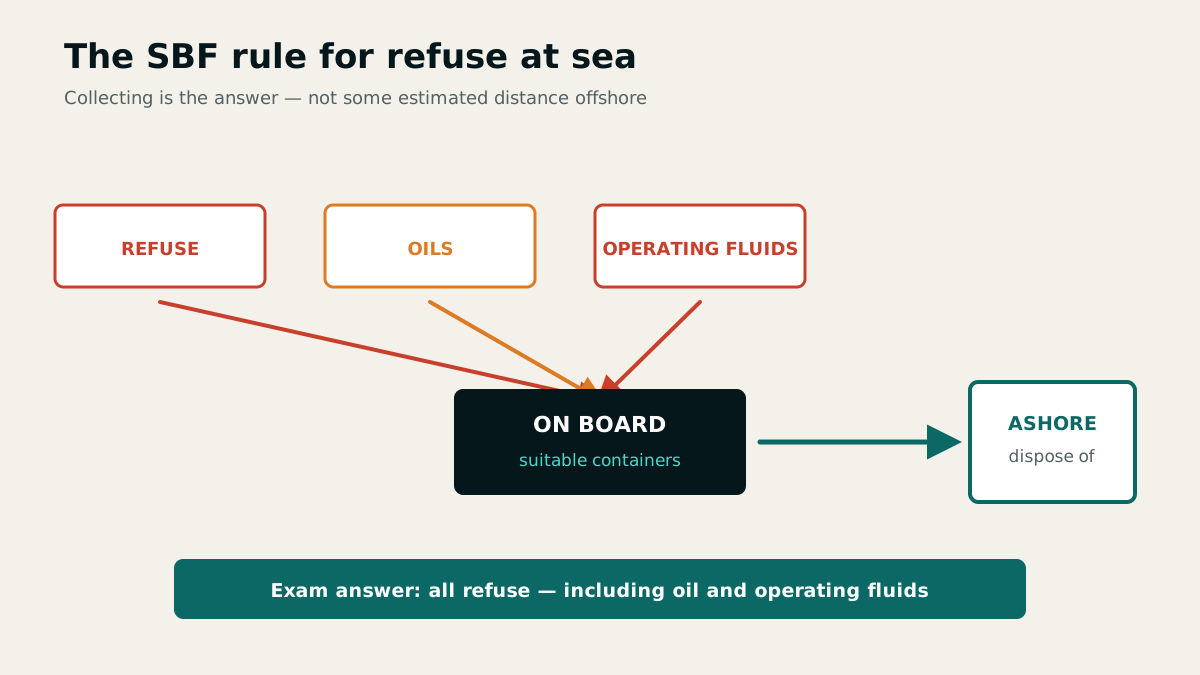
For keeping the water clean the obligation is plain: collect all refuse, including oils and operating fluids, in suitable containers on board and dispose of it ashore as the rules require.
When navigating in nature reserves and national parks the rule is simply: observe the navigation provisions.