01
Two conditions, two ambiguities.
What is required are nautical miles “on sailing yachts with an engine in coastal waters” (auf Segelyachten mit Antriebsmaschine in den Küstengewässern). That leaves two terms in the room which the guidelines do not define any further: yacht (Yacht) and coastal waters (Küstengewässer).
All that follows directly from the wording is the part that is clear: a craft without an engine does not meet the condition. A dinghy without an engine is therefore ruled out, whatever the sailing area.
Primary sourceNo. 1 of the SKS implementing guidelines (Durchführungsrichtlinien SKS, ELWIS)
02
The grey areas.
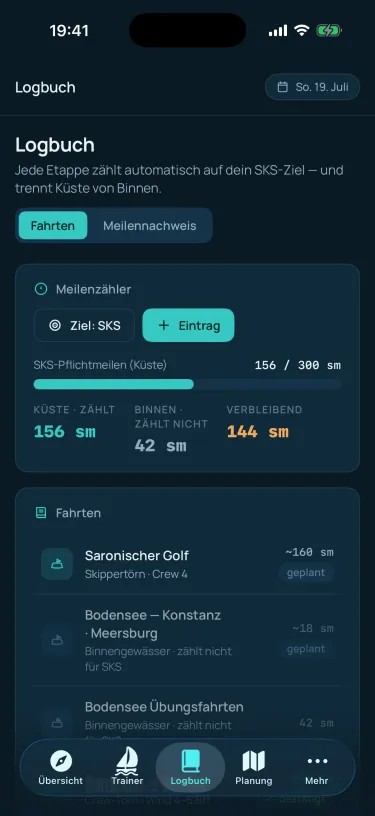
Inland waters such as Lake Constance (Bodensee) are generally not regarded as coastal waters – here practice is unambiguous, even though an official definition is missing. Areas such as the IJsselmeer, which is separated from the sea by the enclosure dam (Abschlussdeich), are disputed.
For everything that is not obviously coastal, the same advice applies as for proof of miles in general: ask beforehand rather than argue afterwards. The examination body responsible can tell you whether it accepts the specific proof.
03
Charter yacht, crewing, your own boat.
The guidelines draw no distinction between owning the boat, having chartered it or having sailed along as crew. What is required is proof of the miles sailed, not proof of ownership.
What matters is the documentation: date, boat, sailing area, distance – and a confirmation by the skipper (Schiffsführer).
FAQ
Frequently asked questions
Do miles on Lake Constance count?
In general practice they do not, because inland waters are not coastal waters. The guidelines, however, contain no official definition of the term “coastal waters” (Küstengewässer).
Do miles sailed in a dinghy count?
What is required are miles on sailing yachts with an engine. A dinghy without an engine does not meet that condition.
Do I have to have been the skipper?
No. The guidelines require proof of the nautical miles sailed, not that you were in command of the boat.